Allometric equations describe the proportional relationships between tree dimensions, such as the relationship between a tree’s diameter and its height, biomass or crown size. Across a population these dimensions are statistically related because trees share the same pattern of development from seedling to maturity (Gould, 1966), and the relationships hold across tree sizes, from saplings to canopy dominants, where growing conditions are similar (Archibald & Bond, 2003; Bohlman & O’Brien, 2006; Dietze et al., 2008; King, 1996).
REDD+ carbon accounting rests on this principle, because allometric equations convert field measurements of diameter at breast height (DBH) into biomass estimates, and every emission reduction is quantified from those estimates.
Allometry Investment
Section 8 exempts structural allometric uncertainty when a model is applied consistently, but the choice of model still sets the reported uncertainty, because allometric variance is absolute, compounds through every later step and cannot be exempted downstream. A model with 20 per cent RMSE rather than 8 per cent RMSE is the difference between a 6 per cent and a 2 per cent carbon credit deduction, worth $200k in a 1M tCO2-e project at $5/tonne.
# Installer prerequisitesimport subprocess, sys# Quick package install subprocess.run([sys.executable, "-m", "pip", "install", "--quiet", "-q","contextily", "folium", "geopandas", "kaleido", "matplotlib", "numpy", "openpyxl", "pandas", "plotly", "pysal", "pyproj", "pingouin","rasterio","scikit-learn", "scipy", "seaborn", "statsmodels", "shapely", "skimpy","xarray"], check=True, capture_output=True)# Import packages into runtimeimport pandas as pd, numpy as npimport matplotlib.pyplot as plt, seaborn as snsimport plotly.express as px, plotly.graph_objects as gofrom sklearn.ensemble import RandomForestClassifier, RandomForestRegressorfrom sklearn.model_selection import train_test_splitfrom scipy import statsimport geopandas as gpd, rasterio, foliumfrom tabulate import tabulate
1.1 Allometric Equations
In its broadest sense, allometry describes any linear or non-linear correlation between increases in tree dimensions during development (Picard et al., 2012). A narrower definition, from Huxley (1924), refers only to a proportional relationship between the relative increases in two dimensions, written as
Allometric equations predict aboveground biomass from diameter using species- or biome-specific parameters, and their uncertainty compounds from three sources, model selection, parameter estimation and field measurement. Log-transformation adds a further step, because predictions on the log scale must be back-transformed to the original scale.
The power-law form reflects the self-similarity seen in tree growth, in that trees keep the same proportional relationships between their dimensions as they develop from seedling to maturity (Gould, 1971). The exponent β is the allometric coefficient and quantifies how one dimension changes relative to another during growth, so that with β = 2.5 a 10 per cent increase in diameter corresponds to a 25 per cent increase in biomass. The parameter α is a scaling constant that accounts for wood density, architectural form and other species-specific traits.
West et al. (1997) and Enquist et al. (1999) developed an allometric scaling theory from the pipe model (Shinozaki et al., 1964) and physical principles of growth, which predicts a universal exponent of β ≈ 2.67 from biomechanical constraints, tree stability and hydraulic resistance. Whether the exponent is universal has been debated (Muller-Landau et al., 2006; Zianis & Mencuccini, 2004), but it remains a physically grounded benchmark against which empirical equations can be judged.
This chapter compares species-specific allometry with the biome-generic equations more commonly applied in REDD+ programs, to show how uncertainty metrics can inform model selection and how that choice changes carbon credit deductions. Allometry is taken in its broadest sense, as any correlation between tree dimensions, whether linear, log-log, power-law or another functional form, and the chapter examines two questions.
How should uncertainty metrics inform model selection and optimization?
How does allometric uncertainty change carbon credit deductions?
1.2 Model Selection
The choice of allometric equation sets the size of the uncertainty and of the carbon credit deduction. This section shows the differences between equation categories using the scbi_stem1 dataset from the ForestGEO plot inventory in Front Royal, Virginia, a 25.6-hectare mature secondary forest dominated by Appalachian mixed hardwoods, including tulip poplar (Liriodendron tulipifera), oaks (Quercus spp.) and hickories (Carya spp.), which is a typical stand composition for the Blue Ridge and Piedmont regions.
REDD+ carbon accounting relies almost entirely on ontogenic allometry, the relationship between measurable tree dimensions and total aboveground biomass as a tree grows from seedling to maturity. Some knowledge of evolutionary allometry, the differences in traits that arose under local conditions, is still needed at times, because species within one genus can differ in wood density, branch architecture and bole form. Red maple (Acer rubrum) has a lower density (0.49 g/cm³) and faster growth, sugar maple (Acer saccharum) a higher density (0.63 g/cm³) and denser wood, and box elder (Acer negundo) an intermediate density (0.42 g/cm³) and a different architecture.
Types of Equations
Allometric equations are classified by taxonomic scope and environmental specificity, and the choice of category is a balance of precision, cost and data availability. Species-specific equations are developed from destructive sampling of the target species and give the highest accuracy but limited geographic applicability (Gonzalez-Akre et al., 2022), because they capture the traits of that species, such as branching architecture and wood density, that set its biomass allocation. Genus-specific equations are aggregated across several species within a genus and offer broader applicability with moderate accuracy (Jansen et al., 1996; Jenkins, 2004), on the assumption that shared evolutionary heritage produces similar scaling within a genus.
Biome-generic equations, the most common in REDD+ reports, are pan-tropical equations fitted across broad regions and biomes, which maximizes applicability but can introduce bias (Brown, 1997; Chave et al., 2009; Chave et al., 2014; West et al., 1997), and they often include wood density (WD) or an environmental stress factor to capture regional variation. Environmentally conditioned equations are the gold standard and include biophysical variables that reflect the growing conditions of the site, which matters for REDD+ programs in specialized ecosystems (Komiyama et al., 2005, 2008; Rahman et al., 2021). These equations model the environmental causes of growth variation directly, such as the salinity gradient in a mangrove, where salt stress changes growth rate, wood density and form, the soil fertility that shapes wood density and the height-diameter relationship, the temperature and precipitation gradients captured by an environmental stress factor, and the geomorphology of tidal inundation, elevation or hydrological regime.
Mangroves Tree Height
In specialized growing environments such as mangroves, the choice of allometry has a large effect on accuracy. Rocha de Souza Pereira et al. (2018) found that generic allometries produced error margins -18 per cent and +14 per cent wider than species-specific equations in Brazilian mangrove forests. Generic equations compensate by including proxies of environmental stress, such as wood density, height-diameter ratio or stunting, and species composition.
Including tree height reduces bias in AGB estimates (Chave et al., 2014; Rutishauser et al., 2013), but tree height is hard to measure accurately in closed-canopy forest (King & Clark, 2011), and field data with high variance in height limit the destructively sampled models built on them. Better survey technology, such as LiDAR and RADAR, is therefore an investment that reduces uncertainty (Feldpausch et al., 2011; Valbuena et al., 2016).
Data Preparation
The scbi_stem1 dataset was imported from the allodb package. It holds 2,287 individual tree measurements from the ForestGEO permanent plot at Front Royal, Virginia, across 12 families and many genera and species (Table 1.1), a diversity that allows equation selection to be shown at each level of specificity.
View Code
# import dataset from allodb.pkglibrary("allodb")data(scbi_stem1)#scbi_stem1 |> dplyr::group_by(Family) |># dplyr::summarise(`Tree Families sampled` = n()) |># flextable::flextable()|> flextable::autofit()scbi_stem1|>dplyr::group_by(Family, genus, species)|>dplyr::summarise(`Total Trees (n)` =n())|>flextable::flextable()|>flextable::fontsize(size =9, part ="body")|>flextable::fontsize(size =8, part ="footer")|>flextable::set_table_properties(scbi_stem1, layout ="autofit", width=1, align ="center")
A full allometry workflow would repeat the process below for every genus in the field dataset, adding equations species by species, which is beyond the scope of this training. A brief demonstration of how to add each new equation with allodb operations is given instead.
scbi_stem1 was filtered to Quercus, the largest genus in the sample, so that the scaling of generic allometry could be compared with species and genus equations. Rows with missing entries were also removed, leaving 84 stems from the dataset’s 2,287 trees. The variables kept were
dbh, diameter at breast height (cm)
genus, the taxonomic genus
species, the species epithet
Family, the taxonomic family
Two subsets were created for the comparison, a genus-level dataset of all Quercus observations (n=84 stems) and a species-specific subset of Quercus rubra. Missing DBH values were removed before any allometric calculation. The filtering procedure is given in full in Section 1.6.
View Code
# Genus-specific subsample of datasetscbi_quercus=scbi_stem1|>dplyr::filter(!is.na(dbh))|>dplyr::filter(genus=="Quercus")# Species-specific subsample of datasetscbi_quercus_rubra=scbi_stem1|>dplyr::filter(!is.na(dbh))|>dplyr::filter(genus=="Quercus")|>dplyr::filter(species=="rubra")
Variable
n
mean
sd
median
min
max
skew
kurtosis
se
DBH (cm)
84.000
27.795
20.177
25.980
1.040
83.500
0.438
-0.719
2.202
genus*
84.000
1.000
0.000
1.000
1.000
1.000
0.000
species*
84.000
3.155
1.167
3.000
1.000
5.000
-0.568
-0.369
0.127
Family*
84.000
1.000
0.000
1.000
1.000
1.000
0.000
At this stage it helps to scan the range and spread of the DBH values, because candidate equations can be filtered directly by their minimum and maximum DBH, and the deviation from the mean indicates which statistical steps will be needed later in equation selection, bias correction and model optimization. It also informs the sampling design.
Following forest inventory practice (Duncanson et al., 2021), equation selection proceeds through four criteria in order of priority.
Geographic proximity, preferring equations developed in climates and soils similar to the project area
Taxonomic specificity, preferring species-level over genus-level over family-level equations
DBH range coverage, requiring that the equation’s range spans at least 80 per cent of the measured diameter distribution
Sample size, requiring a minimum of n=50 trees for a species-specific equation and n>150 for a genus-level equation2
The allodb equations database holds 570 allometric equations with 47 metadata fields that record provenance, geographic origin, taxonomic scope, DBH range, sample size and model fitting parameters. The fields used in selection are the geographic coordinates, the equation taxa, the allometry specificity (species, genus or family), the minimum and maximum DBH, the sample size and the bias correction status. The complete metadata structure is listed in Section 1.6.
Table X. Variables in the equations metadata of the allodb package that are available as selection criteria.
Navigating Databases
Filter the allodb database by latitude and longitude rather than by the geographic_area field, whose entries are inconsistent. The filter below uses dplyr. Once the equation is identified, it must be re-selected with the native allodb function new_equations() and the equation’s ID (Gonzalez-Akre et al., 2025).
Later cells import pan-tropical equations and fit them with values from the Global Wood Density database using the computeAGB() and getWoodDensity() functions of the BIOMASS package (Réjou-Méchain, Tanguy, Piponiot, Chave, & Herault, 2017a).
Geographic Filter
In the first step, equations were filtered to North America using latitude bounds of 24-72°N and longitude bounds of -168 to -52°W, which keeps the climate similar to that of the Front Royal, Virginia site (Cfa, humid subtropical). The filter retained 157 equations of the original 570, including equations developed in temperate forests across the eastern United States, southeastern Canada and Alaska.
View Code
# Simple North America filtereq_region<-equations|>dplyr::mutate(lat =as.numeric(lat), long =as.numeric(long))|>dplyr::filter(!is.na(lat), !is.na(long), lat>=24, lat<=72, long>=-168, long<=-52)# tabulateshow_cols=c("ref_id", "equation_taxa", "allometry_specificity", "equation_allometry")head(eq_region[, show_cols])|>flextable::flextable()|>flextable::fontsize(size =9, part ="all")|>flextable::set_table_properties(layout ="autofit", width =1)
ref_id
equation_taxa
allometry_specificity
equation_allometry
barney_1977_bdac
Picea mariana
Species
exp(3.63+2.54*log(dbh))
baskerville_1966_dmpi
Picea glauca
Species
exp(0.15+2.48*log(dbh))
bond-lamberty_2002_aabb
Larix laricina
Species
10^(2.648+0.715*(log10(dbh)))
bond-lamberty_2002_aabb
Salix
Genus
10^(2.481+1.19*(log10(dbh)))
bridge_1979_fpom
Quercus velutina
Species
exp(-0.34052+2.65803*log(dbh))
brown_1976_esbf
Juniperus communis
Species
exp(4.081+2.202*(0.36738 + 0.94932*log(dbh)))
View Code
#flextable::flextable(eq_region[, show_cols]) |> flextable::autofit() # complete list for Appendixcat(sprintf("Equations valid to region: %d\n", nrow(eq_region)))NA Equations valid to region:157
Taxonomic Filter
View Code
# species-specific equations for all Quercus subspecies of North America eq_region_species<-eq_region|>dplyr::filter(allometry_specificity=="Species")|>dplyr::filter(grepl("^Quercus", equation_taxa, ignore.case =TRUE)|# Starts with "Quercus"(allometry_specificity%in%c("Genus", "Family")&grepl("Quercus", equation_taxa, ignore.case =TRUE)))# genus-specific equations for Quercus populations of North America eq_region_genus=eq_region|>dplyr::filter(allometry_specificity=="Genus")|>dplyr::filter(grepl("^Quercus", equation_taxa, ignore.case =TRUE)|# Starts with "Quercus"(allometry_specificity%in%c("Genus", "Family")&grepl("Quercus", equation_taxa, ignore.case =TRUE)))# tabulateflextable::flextable(eq_region_species[, show_cols])|>flextable::fontsize(size =9, part ="all")|>flextable::set_table_properties(layout ="autofit", width =1)
ref_id
equation_taxa
allometry_specificity
equation_allometry
bridge_1979_fpom
Quercus velutina
Species
exp(-0.34052+2.65803*log(dbh))
chapman_1991_apac
Quercus rubra
Species
exp(-2.972-0.017*dbh+2.873*(log(dbh)))
clark_1986b_wvap
Quercus alba
Species
1.73738*(dbh^2)^1.33404
clark_1986b_wvap
Quercus alba
Species
1.69511*(dbh^2)^1.33917
clark_1986b_wvap
Quercus coccinea
Species
1.62952*(dbh^2)^1.34103
clark_1986b_wvap
Quercus coccinea
Species
2.94915*(dbh^2)^1.21733
clark_1986b_wvap
Quercus prinus
Species
0.86674*(dbh^2)^1.47585
clark_1986b_wvap
Quercus prinus
Species
3.40602*(dbh^2)^1.19049
clark_1986b_wvap
Quercus rubra
Species
3.06739*(dbh^2)^1.22338
clark_1986b_wvap
Quercus rubra
Species
3.28071*(dbh^2)^1.20936
clark_1986b_wvap
Quercus velutina
Species
1.2927*(dbh^2)^1.36723
clark_1986b_wvap
Quercus velutina
Species
2.5465*(dbh^2)^1.22586
martin_1998_aban
Quercus alba
Species
10^(-1.266+2.613*(log10(dbh)))
martin_1998_aban
Quercus coccinea
Species
10^(-1.283+2.685*(log10(dbh)))
martin_1998_aban
Quercus prinus
Species
10^(-1.587+2.910*(log10(dbh)))
martin_1998_aban
Quercus rubra
Species
10^(-1.259+2.644*(log10(dbh)))
perala_1994_abef
Quercus rubra
Species
0.1335*(dbh^2.422)*((3.706*dbh^0.4932)^0.4389)
this_study
Quercus agrifolia
Species
24.2*(1-exp(-0.0466*dbh^0.8183))
this_study
Quercus parvula
Species
1.8219*dbh^0.6332
View Code
#flextable::flextable(eq_region_genus[, show_cols]) |> flextable::autofit()cat(sprintf("Genus-specific equations valid to region: %d\n", nrow(eq_region_genus)))NA Genus-specific equations valid to region:1cat(sprintf("Species-specific equations valid to region: %d\n", nrow(eq_region_species)))NA Species-specific equations valid to region:19
DBH Filter
View Code
# filter genus-specific equations by DBH range of field datafield_dbh_min<-min(scbi_quercus$dbh, na.rm =T)# 1.04 cmfield_dbh_max<-max(scbi_quercus$dbh, na.rm =T)# 83.5 cmeq_region_genus_dbh<-eq_region_genus|>dplyr::mutate( dbh_min_cm =as.numeric(dbh_min_cm), dbh_max_cm =as.numeric(dbh_max_cm))|>dplyr::filter(!is.na(dbh_min_cm), !is.na(dbh_max_cm),# extrapolation of saplings (min=20cm), compensated in Step 5 (risk if high sapling count)dbh_min_cm<=field_dbh_min*20, dbh_max_cm>=field_dbh_max)eq_region_species_dbh<-eq_region_species|>dplyr::mutate( dbh_min_cm =as.numeric(dbh_min_cm), dbh_max_cm =as.numeric(dbh_max_cm))|>dplyr::filter(!is.na(dbh_min_cm), !is.na(dbh_max_cm),dbh_max_cm>=field_dbh_max*0.7)# extrapolation of crowns allowed, consider outliersflextable::flextable(eq_region_genus_dbh[, show_cols])|>flextable::fontsize(size =9, part ="all")|>flextable::set_table_properties(layout ="autofit", width =1)
ref_id
equation_taxa
allometry_specificity
equation_allometry
stovall_2018_ibca
Quercus sp.
Genus
exp(-1.5091+2.3237*log(dbh))+0.24
View Code
flextable::flextable(eq_region_species_dbh[, show_cols])|>flextable::fontsize(size =9, part ="all")|>flextable::set_table_properties(layout ="autofit", width =1)
ref_id
equation_taxa
allometry_specificity
equation_allometry
chapman_1991_apac
Quercus rubra
Species
exp(-2.972-0.017*dbh+2.873*(log(dbh)))
clark_1986b_wvap
Quercus rubra
Species
3.28071*(dbh^2)^1.20936
martin_1998_aban
Quercus alba
Species
10^(-1.266+2.613*(log10(dbh)))
this_study
Quercus agrifolia
Species
24.2*(1-exp(-0.0466*dbh^0.8183))
View Code
cat(sprintf("Genus-specific equations valid for region, Quercus, & DBH range: %d\n", nrow(eq_region_genus_dbh)))NA Genus-specific equations valid for region, Quercus, & DBH range:1cat(sprintf("Specific-specific equations valid for region, Quercus, & DBH range: %d\n", nrow(eq_region_species_dbh)))NA Specific-specific equations valid for region, Quercus, & DBH range:4view(equations)
Sample Size Filter
The sample size needed to develop an allometric equation depends on the precision required and on the diameter distribution. Roxburgh et al. (2015) showed by Monte Carlo resampling that a biomass prediction with a standard deviation within 7.5 per cent of the mean needs between 17 and 166 trees, depending on the algorithm, and that stratified sampling across age class or DBH size does most to improve precision.
Following Roxburgh et al. (2015), a minimum sample size of n ≥ 17 was applied so that every retained equation rested on an adequate destructive sampling campaign. The threshold balances the precision requirement (coefficient of variation ≤7.5 per cent) against the cost of destructive sampling. Stratification across DBH size classes during equation development matters as much, because it captures the biomass variance across age cohorts.
View Code
eq_region_genus_dbh_sample<-eq_region_genus_dbh|>dplyr::filter(sample_size>=17)# Minimum for genus-specific equationseq_region_species_dbh_sample<-eq_region_species_dbh|>dplyr::filter(sample_size>=17)# Minimum for species-specific equations# Display selected equations & tally valid equations remainingflextable::flextable(eq_region_genus_dbh_sample[, show_cols])|>flextable::fontsize(size =9, part ="all")|>flextable::set_table_properties(layout ="autofit", width =1)
ref_id
equation_taxa
allometry_specificity
equation_allometry
stovall_2018_ibca
Quercus sp.
Genus
exp(-1.5091+2.3237*log(dbh))+0.24
View Code
flextable::flextable(eq_region_species_dbh_sample[, show_cols])|>flextable::fontsize(size =9, part ="all")|>flextable::set_table_properties(layout ="autofit", width =1)
ref_id
equation_taxa
allometry_specificity
equation_allometry
clark_1986b_wvap
Quercus rubra
Species
3.28071*(dbh^2)^1.20936
this_study
Quercus agrifolia
Species
24.2*(1-exp(-0.0466*dbh^0.8183))
View Code
cat(sprintf("Genus-specific equations meeting all criteria: %d\n", nrow(eq_region_genus_dbh_sample)))NA Genus-specific equations meeting all criteria:1cat(sprintf("Species-specific equations meeting all criteria: %d\n", nrow(eq_region_species_dbh_sample)))NA Species-specific equations meeting all criteria:2
Criterion
Threshold
Selected_Value
Justification
Geography
North America (24-72°N, -168 to -52°W)
157 equations in region
Climate similarity to Front Royal, VA (Cfa)
Taxonomy
Species > Genus > Family
1 genus-level, 19 species-specific
Species-specific preferred; genus fallback acceptable
DBH Range
≥80% field data coverage
1.0-83.5 cm (field), 11-93 cm (equation)
Minor extrapolation for saplings (<5% biomass)
Sample Size
≥50 (Roxburgh et al. 2015)
n=66 (Stovall 2018)
Meets precision threshold of CV=7.5%
Table X. Equation selection documentation for REDD+ MRV
Attribute
Detail
Equation taxa
Quercus spp. (genus-level)
Biomass method
Non-destructive estimation using terrestrial laser scanning (TLS) to model tree volume, which was then converted to biomass using published wood density values.
Geographic location
Front Royal, Virginia, USA (Smithsonian Conservation Biology Institute, SCBI) at 38.89 N, -78.15W.
Empirical data
The models were developed from 258 non-destructive volume and biomass estimates across 10 dominant hardwood species in this temperate mixed deciduous forest. The equation is a site-specific genus model.
Rationale for selection
This equation is the most geographically and ecologically similar candidate, because it was developed at the same site (SCBI in Virginia) from which the sample data are drawn. Although it is a genus-level equation for Quercus rather than species-specific, the climate similarity (Cfa, temperate forest) and geographic proximity mean that the allodb weighting framework assigns it the maximum weight, making it the highest priority candidate for Quercus trees at this site.
Citation
Stovall, A. E., Anderson-Teixeira, K. J., & Shugart, H. H. (2018). Terrestrial LiDAR-derived non-destructive woody biomass estimates for 10 hardwood species in Virginia. Data in brief, 19, 1560-1569
Attribute
Detail
Equation taxa
Quercus rubra (species-level)
Biomass method
Destructive harvesting (dimensional analysis), the traditional method of felling, weighing and drying tree components to measure biomass directly.
Geographic location
West Virginia, USA (Monongahela National Forest).
Empirical data
A species-specific equation developed for northern red oak (Quercus rubra). The sample size is smaller than that of a meta-analysis but the measurements are direct.
Rationale for selection
This equation is an exact species match for Quercus rubra. Its location in West Virginia is less close than the Stovall (2018) site but lies in the same Appalachian temperate forest region of the eastern United States, and it is both a check on the genus equation and a source of direct measurements from the gold-standard destructive method. allodb balances its lower geographic proximity against its higher taxonomic specificity, making it the strongest secondary candidate.
Citation
Clark, A. (1985). Weight, volume, and physical properties of major hardwood species in the Gulf and Atlantic Coastal Plains (Vol. 250). US Department of Agriculture, Forest Service, Southeastern Forest Experiment Station
Combining Equations
The functions below consolidate the filtered allometric equations into one combined database ready for the final inventory biomass estimates. The allodb functions named here apply a weighted synthesis to the candidate equations.
weight_allom() assigns each candidate equation a weight from three criteria, and the weight sets the equation’s influence on the final result. Equations from larger destructive sampling campaigns (n > 100) receive higher weights; species-specific equations are weighted above genus-level equations, which in turn outweigh family-level equations; and equations developed at nearby locations with similar temperature and precipitation take priority.
resample_agb() runs a Monte Carlo resampling procedure that builds a synthetic dataset from the weighted equations. Each candidate equation is resampled within its original DBH range, the number of resampled values per equation is proportional to its weight, and a default of 10,000 iterations (1e4 in the demonstration) gives a stable representation of the uncertainty distribution. The synthetic dataset holds the collective information of all weighted equations across the full DBH range observed in the target forest.
est_params() then fits the following nonlinear power-law model to the synthetic data,
\[
AGB = \alpha \ * \ DBH^b \ + \ \epsilon
\]
which yields three location-specific parameters. The scaling coefficient ⍺ reflects local wood density and architecture, the allometric exponent 𝒃 typically lies between 2.3 and 2.7 and reflects biomechanical constraints, and the residual standard deviation σ quantifies the prediction uncertainty of the calibrated equation. The resulting equation is location-specific but informed by the broader taxonomic and geographic patterns held in the weighted source equations.
View Code
# This table includes filtered default Acer equations AND custom new equations.eq_tab_combined<-new_equations( subset_taxa ="Quercus", new_taxa =c("Quercus ilex", "Castanea sativa"), new_allometry =c("0.12*dbh^2.5", "0.15*dbh^2.7"), new_coords =c(4, 44), new_min_dbh =c(5, 10), new_max_dbh =c(35, 68), new_sample_size =c(143, 62))# The get_biomass() function internally performs the weighting, resampling,# and calibration based on the equations in eq_tab_combined.agb_custom_estimate<-get_biomass( dbh =50,genus ="Quercus", species ="rubrum", coords =c(-78.2, 38.9), new_eqtable =eq_tab_combined# Use the consolidated custom table)# Print the resulting AGB estimateprint(paste("Estimated AGB using the combined custom table:", agb_custom_estimate, "kg"))
The weighted synthesis gives nearby, species-specific equations with larger sample sizes the greatest influence on the calibrated model, so the result draws on every weighted candidate while reflecting local wood density and architecture. Implementation details are in Section 1.6.
Allometry Best Practices
Document every criterion and threshold, keep the workflow in code so that it can be audited, filter by geography and taxonomy to reduce systematic error to the species level, and keep several candidate equations so that a sensitivity analysis is possible (Section 1.5).
Biomass Estimations
With the candidate species equations identified, their aboveground biomass estimates were compared with those of biome-generic equations (Brown, 1997; Chave et al., 2014). The pan-tropical equations were chosen despite the geographic mismatch, so that the difference in uncertainty would show how much geography matters to allometric calibration.
Aboveground biomass was calculated for all 84 Quercus stems using five approaches.
Species-specific (allodb weighted synthesis), a location-optimized equation drawing on several Quercus species equations
Genus-level (Stovall 2018), a site-specific Quercus equation from the same SCBI plot
Chave et al. 2014 (pan-tropical moist), a generic equation that includes wood density and an environmental stress factor
Chave et al. 2005 (pan-tropical), an earlier generic form using DBH and wood density
Brown 1997 (tropical), a widely used generic equation on DBH alone
Wood density values were taken from the Global Wood Density database (Vieilledent et al., 2018) through the BIOMASS package, giving a mean WD of 0.630 g/cm³ for Quercus, consistent with oak hardwood density. The output of the Chave 2014 equation had to be converted from Mg to kg (×1000; Chave et al, 2014, Réjou-Méchain, Tanguy, Piponiot, Chave, & Hérault, 2017), and the Brown 1997 output divided by 100 to match the original scale. Without these unit conversions the equations cannot be compared (see Section 1.6 for the implementation).
View Code
# once allometry equation is confirmed, use native allodb to load iteq_region_genus_dbh_sample=allodb::new_equations(subset_ids ="a664c1")# species-specific biomass estimates scbi_quercus$agb_species<-allodb::get_biomass( dbh =scbi_quercus$dbh, genus =scbi_quercus$genus, species =scbi_quercus$species, coords =c(-78.2, 38.9))# genus-specific biomass estimatesscbi_quercus$agb_genus<-allodb::get_biomass( dbh =scbi_quercus$dbh, genus =scbi_quercus$genus, species =scbi_quercus$species, coords =c(-78.2, 38.9), new_eqtable =eq_region_genus_dbh_sample)
Always check whether an equation needs a unit conversion or a scaling limit. The most widely used allometric equation, from Chave et al (2014), needs conversion from megagrams to kilograms, as shown below (* 1000).
View Code
# derive generic estimates using standard equationswood_densities<-BIOMASS::getWoodDensity( genus =scbi_quercus$genus, species =scbi_quercus$species, stand =scbi_quercus$Plot)scbi_quercus$WD<-wood_densities$meanWD# Chave et al 2014scbi_quercus$agb_chave2014<-BIOMASS::computeAGB( D =scbi_quercus$dbh, WD =scbi_quercus$WD, coord =c(-78.2, 38.9))# convert unitsscbi_quercus$agb_chave2014=scbi_quercus$agb_chave2014*1000# Chave et al 2005 (MANUAL Fit)scbi_quercus$agb_chave2005<-scbi_quercus$WD*exp(-1.499+2.148*log(scbi_quercus$dbh)+0.207*(log(scbi_quercus$dbh))^2-0.0281*(log(scbi_quercus$dbh))^3)# Brown et al 1997 (MANUAL Fit)scbi_quercus$agb_brown1997<-exp(2.134+2.53*log(scbi_quercus$dbh))scbi_quercus$agb_brown1997=scbi_quercus$agb_brown1997/100flextable::flextable(scbi_quercus)|>flextable::fontsize(size =9, part ="all")|>flextable::set_table_properties(layout ="autofit", width =1)
treeID
stemID
dbh
genus
species
Family
agb_species
agb_genus
WD
agb_chave2014
agb_chave2005
agb_brown1997
6,014
6,014
8.80
Quercus
alba
Fagaceae
41.7637958
34.6344546
0.6300
7.28909988
29.9737527
20.71693889
6,201
6,201
41.72
Quercus
alba
Fagaceae
1,290.4913814
1,287.8799035
0.6300
369.67536146
1,763.7413271
1,062.32043295
1,158
1,158
29.82
Quercus
alba
Fagaceae
615.5371694
590.2328264
0.6300
161.46721089
748.5947279
454.24357825
3,736
3,736
44.38
Quercus
alba
Fagaceae
1,478.8739694
1,486.7745358
0.6300
430.07341800
2,060.0375737
1,242.13345169
3,741
3,741
1.12
Quercus
alba
Fagaceae
0.4437772
0.2879769
0.6300
0.02849730
0.1799659
0.11253976
6,014
32,937
8.20
Quercus
alba
Fagaceae
35.7428951
29.3933603
0.6300
6.06737169
24.8619475
17.32740278
6,109
6,109
72.18
Quercus
alba
Fagaceae
4,321.0815102
4,602.9666929
0.6300
1,397.59542709
6,762.9023338
4,251.86147125
3,829
3,829
1.75
Quercus
alba
Fagaceae
1.1869883
0.8122677
0.6300
0.09783959
0.4970427
0.34807328
6,065
6,065
66.91
Quercus
alba
Fagaceae
3,656.0028342
3,859.5305575
0.6300
1,164.71639683
5,643.1934452
3,509.75409893
6,122
6,122
26.13
Quercus
alba
Fagaceae
460.0281377
434.2381530
0.6300
116.23508795
531.5668681
325.19741123
3,942
3,942
20.04
Quercus
alba
Fagaceae
256.2896125
234.4031792
0.6300
59.76904328
265.4142731
166.18262526
3,832
3,832
8.75
Quercus
alba
Fagaceae
41.2424636
34.1789382
0.6300
7.18211884
29.5246386
20.42042603
6,198
6,198
18.55
Quercus
alba
Fagaceae
216.1527538
195.8849828
0.6300
49.18605136
216.5281391
136.67671331
3,829
32,657
1.52
Quercus
alba
Fagaceae
0.8700448
0.5854821
0.6300
0.06641044
0.3579301
0.24369616
4,930
4,930
42.89
Quercus
michauxii
Fagaceae
1,373.4642682
1,373.3608400
0.6515
408.00003593
1,955.3844042
1,139.31864776
4,908
4,908
33.74
Quercus
prinus
Fagaceae
807.5290502
786.4119199
0.5700
199.94839362
930.5024048
620.85681481
4,902
4,902
26.56
Quercus
prinus
Fagaceae
476.4422695
451.0228853
0.5700
110.41164268
501.7925319
338.90772523
3,833
3,833
55.13
Quercus
prinus
Fagaceae
2,384.4112362
2,461.0519474
0.5700
665.23436471
3,191.5742054
2,150.28497856
3,861
32,665
31.93
Quercus
prinus
Fagaceae
715.0795197
691.8486167
0.5700
174.45804487
807.7462398
540.01726667
4,883
4,883
16.65
Quercus
prinus
Fagaceae
170.1313989
152.3911925
0.5700
34.12476597
147.2521410
103.98302468
4,945
4,945
7.15
Quercus
prinus
Fagaceae
26.3798528
21.3787654
0.5700
3.87114822
15.6636024
12.25120227
3,841
32,661
3.19
Quercus
prinus
Fagaceae
4.4498892
3.2776221
0.5700
0.45567375
1.9450578
1.58991841
6,105
6,105
38.12
Quercus
prinus
Fagaceae
1,056.9294420
1,044.2728542
0.5700
270.14158890
1,270.1903091
845.47598474
5,006
5,006
48.12
Quercus
prinus
Fagaceae
1,766.6172691
1,794.2757411
0.5700
477.90912983
2,280.9877313
1,524.29234100
4,937
4,937
52.78
Quercus
prinus
Fagaceae
2,166.0259005
2,224.1461809
0.5700
598.47838912
2,867.4570591
1,925.89207151
3,851
3,851
30.39
Quercus
prinus
Fagaceae
641.2312540
616.7790454
0.5700
154.34390938
711.2124639
476.53310154
6,175
6,175
1.06
Quercus
prinus
Fagaceae
0.3919584
0.2533948
0.5700
0.02229260
0.1443867
0.09790577
3,759
3,759
5.41
Quercus
prinus
Fagaceae
14.2631279
11.1837102
0.5700
1.86096287
7.5384467
6.05025214
4,910
4,910
24.54
Quercus
prinus
Fagaceae
400.1816203
375.2995279
0.5700
90.62579821
408.3704247
277.43869296
3,859
3,859
47.92
Quercus
prinus
Fagaceae
1,750.4667155
1,776.9958375
0.5700
473.08038364
2,257.4804788
1,508.31475695
4,921
4,921
49.49
Quercus
prinus
Fagaceae
1,879.4324090
1,915.2122960
0.5700
511.74583227
2,445.6803675
1,636.49080317
3,854
3,854
23.03
Quercus
prinus
Fagaceae
347.8876503
323.8130771
0.5700
77.30652427
345.9194869
236.25885900
4,971
4,971
44.51
Quercus
prinus
Fagaceae
1,487.5100601
1,496.9134623
0.5700
395.04844833
1,877.5514630
1,251.35966700
4,905
4,905
19.73
Quercus
prinus
Fagaceae
247.3597617
226.0642853
0.5700
52.41058628
230.4819305
159.75555463
4,895
4,895
33.33
Quercus
prinus
Fagaceae
786.0488718
764.3861533
0.5700
193.99724551
901.8064724
601.94627008
3,754
3,754
53.48
Quercus
prinus
Fagaceae
2,229.8789323
2,293.2871922
0.5700
617.94106423
2,962.0057034
1,991.17136355
3,758
3,758
29.88
Quercus
prinus
Fagaceae
617.7416800
592.9957612
0.5700
147.99679828
680.8237270
456.55939093
6,105
32,948
29.05
Quercus
prinus
Fagaceae
580.5353679
555.4242351
0.5700
137.99733622
633.0294522
425.15192548
5,015
32,813
30.05
Quercus
prinus
Fagaceae
625.5183651
600.8643974
0.5700
150.09528540
690.8666473
463.15989790
3,861
3,861
47.58
Quercus
prinus
Fagaceae
1,723.1965011
1,747.8381802
0.5700
464.93603183
2,217.8303142
1,481.38595772
6,181
6,181
1.09
Quercus
prinus
Fagaceae
0.4168379
0.2703709
0.5700
0.02409664
0.1534332
0.10506872
6,051
6,051
17.43
Quercus
prinus
Fagaceae
188.2040310
169.4956107
0.5700
38.32204684
166.2015346
116.75267326
4,921
32,798
45.95
Quercus
prinus
Fagaceae
1,595.7024677
1,611.8547626
0.5700
427.01499709
2,033.1946354
1,356.33440775
3,841
3,841
4.07
Quercus
prinus
Fagaceae
7.6147833
5.7729030
0.5700
0.87473536
3.6111657
2.94481692
4,900
4,900
35.01
Quercus
prinus
Fagaceae
876.0796244
856.9104965
0.5700
219.04815032
1,022.7284035
681.69558886
4,941
4,941
19.88
Quercus
prinus
Fagaceae
251.5256581
230.0777621
0.5700
53.42046148
235.1235863
162.84629534
5,015
5,015
51.95
Quercus
prinus
Fagaceae
2,091.6262859
2,143.7233445
0.5700
575.86234802
2,757.5403004
1,850.18804602
3,754
32,644
18.79
Quercus
prinus
Fagaceae
222.1161359
201.8240515
0.5700
46.33847538
202.6626664
141.19494298
4,942
4,942
38.24
Quercus
prinus
Fagaceae
1,064.2799971
1,051.9267603
0.5700
272.23782635
1,280.3611441
852.22575020
4,939
4,939
8.42
Quercus
prinus
Fagaceae
37.8310265
31.2583034
0.5700
5.92783459
24.1268820
18.52780521
6,043
6,043
14.43
Quercus
rubra
Fagaceae
124.3720267
109.2846080
0.5600
23.33392646
99.0210094
72.39828285
3,740
3,740
37.50
Quercus
rubra
Fagaceae
1,022.9397332
1,005.2332291
0.5600
255.26797929
1,197.0066207
811.11705223
4,844
4,844
4.50
Quercus
rubra
Fagaceae
9.5099394
7.2902273
0.5600
1.12427256
4.5933623
3.79675072
4,967
4,967
59.19
Quercus
rubra
Fagaceae
2,800.2155110
2,902.8525462
0.5600
777.41640924
3,730.0673948
2,573.78798878
5,996
5,996
2.38
Quercus
rubra
Fagaceae
2.3324680
1.6595002
0.5600
0.20318978
0.9240671
0.75774676
4,866
4,866
23.28
Quercus
rubra
Fagaceae
357.2923365
332.0392166
0.5600
78.14311997
349.5885982
242.80150157
3,757
3,757
56.39
Quercus
rubra
Fagaceae
2,516.2600962
2,593.7251264
0.5600
691.34613971
3,314.0550756
2,276.80465795
6,176
6,176
83.50
Quercus
rubra
Fagaceae
5,982.8500337
6,457.2112247
0.5600
1,777.37126337
8,469.3561623
6,146.83007285
4,961
4,961
5.91
Quercus
rubra
Fagaceae
17.3523140
13.7336417
0.5600
2.31119112
9.3298900
7.56659907
4,868
4,868
10.05
Quercus
rubra
Fagaceae
55.9887078
47.1558874
0.5600
9.22389498
37.8950021
28.99109110
6,076
6,076
38.59
Quercus
rubra
Fagaceae
1,089.6953435
1,074.4330615
0.5600
273.90764662
1,287.3055373
872.09861504
2,623
2,623
17.00
Quercus
rubra
Fagaceae
178.5575597
159.9381204
0.5600
35.39142453
152.8518749
109.60243314
6,161
6,161
11.30
Quercus
rubra
Fagaceae
72.5157421
61.9200115
0.5600
12.47711209
51.7345785
39.00074350
4,907
4,907
49.98
Quercus
rubra
Fagaceae
1,928.0952178
1,959.5606600
0.5600
515.70304472
2,462.1753315
1,677.79507251
3,677
3,677
38.92
Quercus
rubra
Fagaceae
1,110.3616032
1,095.9023318
0.5600
279.70107400
1,315.3901411
891.09031354
6,162
6,162
50.62
Quercus
rubra
Fagaceae
1,982.9908592
2,018.3579262
0.5600
531.92428266
2,540.9789427
1,732.68440736
6,041
6,041
9.66
Quercus
rubra
Fagaceae
51.3068293
43.0127640
0.5600
8.32711933
34.1164666
26.22868617
3,828
32,656
1.04
Quercus
rubra
Fagaceae
0.3754286
0.2424244
0.5600
0.02079709
0.1361149
0.09329937
3,735
3,735
40.03
Quercus
rubra
Fagaceae
1,181.4363039
1,169.8984836
0.5600
299.70417376
1,412.4159200
956.79728404
6,142
32,955
2.37
Quercus
rubra
Fagaceae
2.3109000
1.6433444
0.5600
0.20088003
0.9146106
0.74971772
4,873
4,873
12.29
Quercus
rubra
Fagaceae
87.2783294
75.2622525
0.5600
15.47986003
64.6640393
48.23371373
4,864
4,864
11.13
Quercus
rubra
Fagaceae
70.1305321
59.7770919
0.5600
11.99996949
49.6929365
37.53334068
6,031
6,031
25.83
Quercus
rubra
Fagaceae
449.3891747
422.7421958
0.5600
101.33350564
458.5174382
315.83417415
6,142
6,142
3.72
Quercus
rubra
Fagaceae
6.2485265
4.6844437
0.5600
0.67693012
2.8196238
2.34562232
3,828
3,828
1.47
Quercus
rubra
Fagaceae
0.8055831
0.5417037
0.5600
0.05433775
0.2945939
0.22392226
6,000
6,000
21.84
Quercus
rubra
Fagaceae
310.3416778
286.2581018
0.5600
66.58020151
295.7446428
206.58251378
4,871
4,871
5.79
Quercus
velutina
Fagaceae
16.5409796
13.0944079
0.5600
2.18970505
8.8423679
7.18391557
5,010
5,010
48.71
Quercus
velutina
Fagaceae
1,813.7548532
1,845.8072228
0.5600
484.36445811
2,309.8804079
1,572.02086480
3,782
3,782
29.62
Quercus
velutina
Fagaceae
605.4843397
581.0757119
0.5600
142.48091704
653.9536822
446.57525689
6,020
6,020
12.18
Quercus
velutina
Fagaceae
85.2885641
73.7063466
0.5600
15.12706577
63.1381551
47.14895719
6,160
6,160
62.59
Quercus
velutina
Fagaceae
3,153.0868571
3,305.1052960
0.5600
889.75082893
4,271.3028221
2,964.43542637
6,145
6,145
48.15
Quercus
velutina
Fagaceae
1,768.0826750
1,796.8758387
0.5600
470.90307235
2,244.4460318
1,526.69766645
6,139
6,139
62.21
Quercus
velutina
Fagaceae
3,111.0191339
3,258.6681381
0.5600
876.76558732
4,208.8442021
2,919.11154588
6,101
6,101
16.18
Quercus
velutina
Fagaceae
159.5534665
142.5822436
0.5600
31.22082197
134.1111885
96.71639363
Table 1D. Aboveground biomass estimates from five allometric equations of different scales
Normality Testing
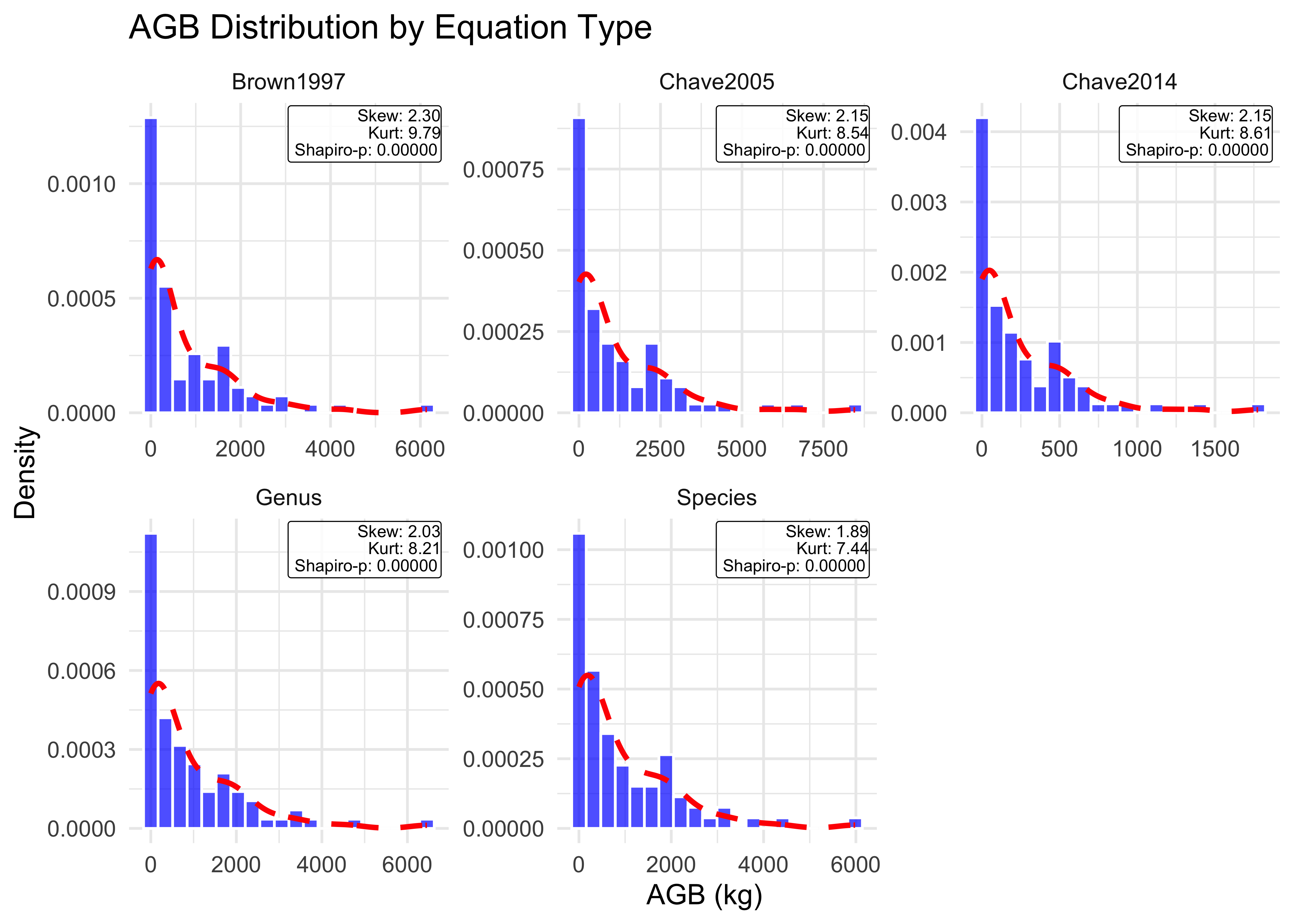
A non-normal distribution violates the assumptions of parametric statistics and inflates the uncertainty estimate, so identifying the true probability distribution allows a transformation that reduces the reported uncertainty and, with it, the carbon credit deduction. Uncertainty modeling depends on an accurate probability density function, and three diagnostics test whether a variable is normally distributed. Skewness and kurtosis quantify asymmetry and tail weight, the Shapiro-Wilk test is a formal test of normality in which p < 0.05 rejects normality, and the Wilcoxon test is a non-parametric test of the median.
DBH and every AGB estimate were non-normal with a strong right skew, which violates the parametric assumptions and justifies log-transformation in the later modeling. A skew of this kind usually reflects a stand of many small trees and few large dominants, and the Shapiro-Wilk results (p < 0.001) confirmed a distribution that would inflate the uncertainty estimate if left untreated.
View Code
# Calculate skewness and kurtosis for DBHdbh_skew=moments::skewness(scbi_quercus$dbh)dbh_kurt=moments::kurtosis(scbi_quercus$dbh)dbh_shapiro=stats::shapiro.test(scbi_quercus$dbh)dbh_wilcox=stats::wilcox.test(scbi_quercus$dbh)# Calculate skewness and kurtosis for each AGB estimateagb_species_skew=moments::skewness(scbi_quercus$agb_species)agb_species_kurt=moments::kurtosis(scbi_quercus$agb_species)agb_species_shapiro=stats::shapiro.test(scbi_quercus$agb_species)agb_species_wilcox=stats::wilcox.test(scbi_quercus$agb_species)agb_genus_skew=moments::skewness(scbi_quercus$agb_genus)agb_genus_kurt=moments::kurtosis(scbi_quercus$agb_genus)agb_genus_shapiro=stats::shapiro.test(scbi_quercus$agb_genus)agb_genus_wilcox=stats::wilcox.test(scbi_quercus$agb_genus)agb_chave2014_skew=moments::skewness(scbi_quercus$agb_chave2014)agb_chave2014_kurt=moments::kurtosis(scbi_quercus$agb_chave2014)agb_chave2014_shapiro=stats::shapiro.test(scbi_quercus$agb_chave2014)agb_chave2014_wilcox=stats::wilcox.test(scbi_quercus$agb_chave2014)agb_brown1997_skew=moments::skewness(scbi_quercus$agb_brown1997)agb_brown1997_kurt=moments::kurtosis(scbi_quercus$agb_brown1997)agb_brown1997_shapiro=stats::shapiro.test(scbi_quercus$agb_brown1997)agb_brown1997_wilcox=stats::wilcox.test(scbi_quercus$agb_brown1997)agb_chave2005_skew=moments::skewness(scbi_quercus$agb_chave2005)agb_chave2005_kurt=moments::kurtosis(scbi_quercus$agb_chave2005)agb_chave2005_shapiro=stats::shapiro.test(scbi_quercus$agb_chave2005)agb_chave2005_wilcox=stats::shapiro.test(scbi_quercus$agb_chave2005)
Variable
n
Mean...SD
Skewness
Kurtosis
Shapiro.Wilk.p
Decision
DBH (cm)
84
27.8 ± 20.2
0.45
2.34
0.002
Log(x) needed?: YES
AGB Species (kg)
84
894.7 ± 1124.2
1.89
7.44
< 0.001
Log(x) needed?: YES
AGB Genus (kg)
84
908.5 ± 1187.6
2.03
8.21
< 0.001
Log(x) needed?: YES
AGB Chave2014 (kg)
84
244.1 ± 333.1
2.15
8.61
< 0.001
Log(x) needed?: YES
AGB Brown1997 (kg)
84
776.5 ± 1085.9
2.30
9.79
< 0.001
Log(x) needed?: YES
AGB Chave2005 (kg)
84
1159.3 ± 1601.6
2.15
8.54
< 0.001
Log(x) needed?: YES
All AGB estimates exhibit significant departure from normality (p < 0.001) with extreme right-skew (skewness > 2) regardless of equation type, justifying log-transformation in subsequent analysis.
Bivariate Testing
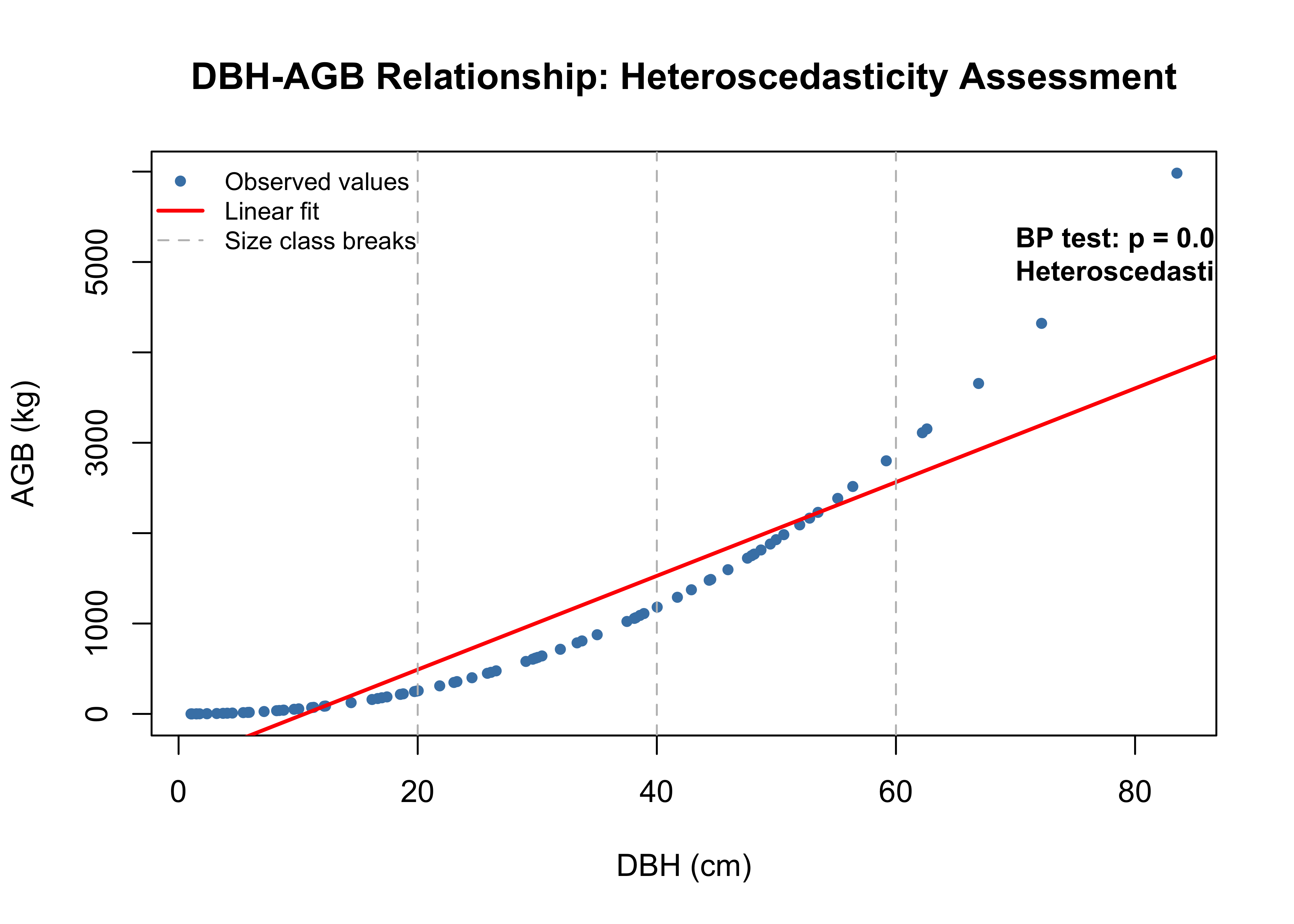
Heteroscedasticity, a variance that changes with the predictor, violates the assumptions of ordinary least squares and produces unreliable standard errors and inflated uncertainty estimates, which cost carbon credit revenue. The Breusch-Pagan test identifies which predictor causes it by regressing the squared residuals on the predictor values, with a null hypothesis (H₀) of constant variance, an alternative (H₁) of variance that changes with the predictor, and a decision rule of p < 0.05 to reject H₀. Large trees show greater prediction variance than small trees because of the power-law scaling (AGB ∝ DBH^2.5), and without correction the uncertainty estimate is biased upward, most of all for the canopy dominants that account for most of the cumulative biomass.
The test returned a Breusch-Pagan statistic of 10.0051 with p = 0.0016, which confirmed heteroscedasticity. The diagnostic plot (Figure 1.2) showed the classic funnel, in that small trees (DBH < 20 cm) clustered tightly around the fitted line while large trees (DBH > 60 cm) scattered widely, because under power-law scaling a small multiplicative error in β becomes a large absolute error for a canopy dominant.
Common Corrections
Three corrections are common, log-transformation of both variables, weighted regression for any residual heteroscedasticity, and robust standard errors to supplement the transformation.
View Code
# Derive results to test non-constant variance of selected predictordbh_agb_species_lm <-lm(agb_species ~ dbh, data = scbi_quercus)bp_test <- lmtest::bptest(dbh_agb_species_lm) cat(sprintf("Breusch-Pagan Test Results:\n"))NA Breusch-Pagan Test Results:cat(sprintf("BP statistic: %.4f\n", bp_test$statistic))NA BP statistic:10.0051cat(sprintf("p-value: %.4f\n", bp_test$p.value))NA p-value:0.0016cat(sprintf("Decision: %s\n", ifelse(bp_test$p.value <0.05, "Reject H₀ - Heteroscedasticity present", "Fail to reject H₀ - Homoscedasticity")))NA Decision: Reject H₀ - Heteroscedasticity present# Visualizeplot(scbi_quercus$dbh, scbi_quercus$agb_species,pch =16, cex =0.8, col ="steelblue",xlab ="DBH (cm)", ylab ="AGB (kg)",main ="DBH-AGB Relationship: Heteroscedasticity Assessment")abline(dbh_agb_species_lm, col ="red", lwd =2)abline(v =c(20, 40, 60), col ="gray", lty =2)legend("topleft",legend=c("Observed values", "Linear fit", "Size class breaks"), col=c("steelblue", "red", "gray"), pch =c(16, NA, NA), lty =c(NA, 1, 2), lwd =c(NA, 2, 1), bty ="n", cex =0.8)text(x =70, y =max(scbi_quercus$agb_species) *0.9,labels =sprintf("BP test: p = %.4f\nHeteroscedasticity confirmed", bp_test$p.value),adj =c(0, 1), cex =0.9, font =2)
The plot confirms that prediction variance grows with tree size under the power-law relationship (AGB ∝ DBH~2.5), and the corrections above are applied in the next section, beginning with log-transformation.
1.3 Model Optimization
Log-Transformation
Linear regression on the untransformed allometric data gives 45-60 per cent uncertainty, and log-transformation reduces RMSE by 51 percentage points. Allometric relationships tend to follow the power law
\[AGB = \alpha \times DBH^{\beta}\]
where β typically lies between 2.3 and 2.7, so that biomass scales with a power of DBH. Fitting this with linear regression (AGB = a + b * DBH) misrepresents the functional form and under- or overestimates particular tree cohorts, and the exponential pattern is pushed into the residuals as noise that inflates uncertainty downstream, which matters for crediting. Taking logarithms of the equation instead linearizes the power law, giving
in which β becomes a slope coefficient, the variance is stable across tree sizes, and the residuals are close enough to normal to satisfy the OLS assumptions on which the predictions depend.
Back-Transformation
The log-scale RMSE must be back-transformed, as shown below, which converts the log-scale error to a proportional error on the original scale and allows direct comparison with the linear model’s uncertainty while keeping the variance structure that the log-transformation stabilized.
Linear and log-transformed regression models were fitted for all five allometric equations and their prediction accuracy compared on three metrics, the mean absolute error (MAE), the average absolute deviation in kg; the root mean square error (RMSE), the standard deviation of the residuals in kg; and the relative RMSE, the RMSE as a percentage of mean biomass, which allows comparison across equations. For the log-transformed models, predictions were back-transformed to the original scale by exponentiation (exp(predicted log-AGB)) and the metrics were calculated on the back-transformed residuals, so that the comparison with the linear models was fair while the variance-stabilizing benefit of the transformation was kept.
The results (Table X) showed a large improvement, in that log-transformation reduced relative RMSE from 45-60 per cent to 0.3-17 per cent across all equation types, a reduction of 40-60 percentage points. The species-specific log model had the lowest uncertainty (0.34 per cent), and even the generic pan-tropical equations improved substantially.
View Code
# Derive performance metrics #lin_species=lm(agb_species~dbh, data =scbi_quercus)lin_genus=lm(agb_genus~dbh, data =scbi_quercus)lin_chave2014=lm(agb_chave2014~dbh, data =scbi_quercus)lin_brown1997=lm(agb_brown1997~dbh, data =scbi_quercus)lin_chave2005=lm(agb_chave2005~dbh, data =scbi_quercus)log_species=lm(log(agb_species)~log(dbh), data =scbi_quercus)log_genus=lm(log(agb_genus)~log(dbh), data =scbi_quercus)log_chave2014=lm(log(agb_chave2014)~log(dbh), data =scbi_quercus)log_brown1997=lm(log(agb_brown1997)~log(dbh), data =scbi_quercus)log_chave2005=lm(log(agb_chave2005)~log(dbh), data =scbi_quercus)# Residuals: log models back-transformed **essentiallin_species_resid=predict(lin_species, scbi_quercus, type='response')lin_genus_resid=predict(lin_genus, scbi_quercus, type="response")lin_chave2014_resid=predict(lin_chave2014, scbi_quercus, type="response")lin_brown1997_resid=predict(lin_brown1997, scbi_quercus, type="response")lin_chave2005_resid=predict(lin_chave2005, scbi_quercus, type="response")log_species_resid=exp(predict(log_species, scbi_quercus))log_genus_resid=exp(predict(log_genus, scbi_quercus))log_chave2014_resid=exp(predict(log_chave2014, scbi_quercus))log_brown1997_resid=exp(predict(log_brown1997, scbi_quercus))log_chave2005_resid=exp(predict(log_chave2005, scbi_quercus))lin_species_mae=ModelMetrics::mae(scbi_quercus$agb_species, lin_species_resid)|>round(4)lin_species_rmse=ModelMetrics::rmse(scbi_quercus$agb_species, lin_species_resid)|>round(4)lin_species_rmse_rel=round(lin_species_rmse/mean(scbi_quercus$agb_species, na.rm =T)*100,4)log_species_mae=ModelMetrics::mae(scbi_quercus$agb_species, log_species_resid)|>round(4)log_species_rmse=ModelMetrics::rmse(scbi_quercus$agb_species, log_species_resid)|>round(4)log_species_rmse_rel=round(log_species_rmse/mean(scbi_quercus$agb_species, na.rm =T)*100,4)# ******** CRITICAL back-transformation = log_species_rmse_rel# Genus-levellin_genus_mae=ModelMetrics::mae(scbi_quercus$agb_genus, lin_genus_resid)|>round(4)lin_genus_rmse=ModelMetrics::rmse(scbi_quercus$agb_genus, lin_genus_resid)|>round(4)lin_genus_rmse_rel=round(lin_genus_rmse/mean(scbi_quercus$agb_genus, na.rm=T)*100,4)log_genus_mae=sprintf("%.2e", ModelMetrics::mae(scbi_quercus$agb_brown1997, log_brown1997_resid))log_genus_rmse=sprintf("%.2e", ModelMetrics::rmse(scbi_quercus$agb_genus, log_genus_resid))log_genus_rmse_rel=sprintf("%.2e", (as.numeric(log_genus_rmse)/mean(scbi_quercus$agb_genus, na.rm=T)*100))# ******** CRITICAL back-transformation = log_genus_rmse_rel ***********# Chave 2014lin_chave2014_mae=ModelMetrics::mae(scbi_quercus$agb_chave2014, lin_chave2014_resid)|>round(4)lin_chave2014_rmse=ModelMetrics::rmse(scbi_quercus$agb_chave2014, lin_chave2014_resid)|>round(4)lin_chave2014_rmse_rel=round(lin_chave2014_rmse/mean(scbi_quercus$agb_chave2014,na.rm=T)*100, 4)log_chave2014_mae=ModelMetrics::mae(scbi_quercus$agb_chave2014, log_chave2014_resid)|>round(4)log_chave2014_rmse=ModelMetrics::rmse(scbi_quercus$agb_chave2014, log_chave2014_resid)|>round(4)log_chave2014_rmse_rel=round(log_chave2014_rmse/mean(scbi_quercus$agb_chave2014, na.rm=T)*100, 4)# Brown 1997lin_brown1997_mae=ModelMetrics::mae(scbi_quercus$agb_brown1997, lin_brown1997_resid)|>round(4)lin_brown1997_rmse=ModelMetrics::rmse(scbi_quercus$agb_brown1997, lin_brown1997_resid)|>round(4)lin_brown1997_rmse_rel=round(lin_brown1997_rmse/mean(scbi_quercus$agb_brown1997, na.rm=T)*100, 4)log_brown1997_mae=sprintf("%.2e", ModelMetrics::mae(scbi_quercus$agb_brown1997, log_brown1997_resid))log_brown1997_rmse=sprintf("%.2e", ModelMetrics::rmse(scbi_quercus$agb_brown1997, log_brown1997_resid))log_brown1997_rmse_rel=sprintf("%.2e", (as.numeric(log_brown1997_rmse)/mean(scbi_quercus$agb_brown1997, na.rm=T)*100))# Chave 2005linear_chave2005_mae=ModelMetrics::mae(scbi_quercus$agb_chave2005, lin_chave2005_resid)|>round(4)linear_chave2005_rmse=ModelMetrics::rmse(scbi_quercus$agb_chave2005, lin_chave2005_resid)|>round(4)linear_chave2005_rmse_rel=(linear_chave2005_rmse/mean(scbi_quercus$agb_chave2005, na.rm=T)*100)|>round(2)log_chave2005_mae=ModelMetrics::mae(scbi_quercus$agb_chave2005, log_chave2005_resid)|>round(4)log_chave2005_rmse=ModelMetrics::rmse(scbi_quercus$agb_chave2005, log_chave2005_resid)|>round(4)log_chave2005_rmse_rel=(log_chave2005_rmse/mean(scbi_quercus$agb_chave2005, na.rm=T)*100)|>round(4)
Equation
MAE_Lin
MAE_Log
RMSE_Lin
RMSE_Log
RMSE_Lin_rel
RMSE_Log_rel
Reduction
Species-specific
306.8919
1.3638
407.8615
3.0036
45.5869
0.3357
45.2469
Genus-level
345.0502
2.48e-12
461.6111
1.56e-12
50.8083
1.72e-13
50.8083
Chave 2014
102.7348
15.5252
138.5064
40.3143
56.7456
16.5166
40.2256
Brown 1997
345.8073
2.48e-12
469.4678
4.70e-12
60.4590
6.05e-13
60.4590
Chave 2005
102.7348
42.0631
469.4678
122.7474
58.0900
10.5881
47.5000
The two tables above justify the cross-validation workflow of the next section, in which log-transformed models are fitted and the uncertainty reduction is quantified under different bias corrections and hyperparameter settings.
Age-Class Stratification Split
Stratification by size class or age cohort is an essential part of forest biomass modeling, because it keeps every diameter class in proportion and so prevents the bias that comes from under-sampling large trees (Duncanson et al., 2021, p. 100; Paul et al., 2017).
Stratified sampling ensures DBH class proportions remain similar between datasets. 'Cal. % of Total' and 'Val. % of Total' show each class as % of its respective dataset. Δ shows absolute difference - values <2% indicate good proportionality preservation.
Table X. Calibration and validation subset proportionality check
Every size class differed by less than 3 per cent between the calibration and validation sets, which confirms that the stratification worked and that neither small trees nor large trees are over- or under-represented in model training.
1.4 Cross-Validation
Cross-validation quantifies out-of-sample prediction error, which guards against over-fitting and gives a realistic uncertainty estimate for the REDD+ carbon credit deduction. Monte Carlo leave-group-out cross-validation (LGOCV) in the caret library is used to test model performance on unseen data, to calculate a robust RMSE, to select the best-performing equation type and to show compliance with ART-TREES and VCS requirements.
Simulation Design
A 100-iteration Monte Carlo cross-validation was run to quantify out-of-sample prediction error and prevent over-fitting. Each iteration
split the data at random into 80 per cent calibration and 20 per cent validation, stratified by DBH class
fitted the model on the calibration data
predicted the validation data
calculated the performance metrics (MAE, RMSE, R²)
The process was repeated for all 10 model configurations, the 5 allometric equations (species-specific, genus, Chave 2014, Brown 1997, Chave 2005) each under 2 transformations (linear and log-transformed). Across the 100 iterations the validation predictions of each model were accumulated, giving an uncertainty estimate that reflects true generalization rather than fit to the training set. The Monte Carlo approach is most valuable for a small dataset (n=84), where a single train-test split can give an unrepresentative result through sampling variance.
View Code
# Define Monte Carlo cross-validation parametersmonte_carlo_100<-caret::trainControl( method ="LGOCV", number =100, # no.# of full cycle resamples p =0.8, # percentage of full cycle resampled savePredictions ="final")# Species-Specific Model: Linear model tuned at species level with un-transformed covslin_species_mc<-caret::train(agb_species~dbh, data =scbi_quercus, method ="lm", na.action =na.omit, trControl =monte_carlo_100)# Species-Specific Model: Logarithmic model tuned at species level withg log-transformed covslog_species_mc<-caret::train(log(agb_species)~log(dbh), data =scbi_quercus, method ="lm", na.action =na.omit, trControl =monte_carlo_100)# Genus-Specific Model: LINEAR model tuned at genus level with un-transformed covslin_genus_mc<-caret::train(agb_genus~dbh, data =scbi_quercus, method ="lm", na.action =na.omit, trControl =monte_carlo_100)# Genus-Specific Model: LOG model tuned at genus level with un-transformed covslog_genus_mc<-caret::train(log(agb_genus)~log(dbh), data =scbi_quercus, method ="lm", na.action =na.omit, trControl =monte_carlo_100)# Chave 2014 models: Generic scaled lin_chave2014_mc<-caret::train(agb_chave2014~dbh, data =scbi_quercus, method ="lm", na.action =na.omit, trControl =monte_carlo_100)log_chave2014_mc<-caret::train(log(agb_chave2014)~log(dbh), data =scbi_quercus, method ="lm", na.action =na.omit, trControl =monte_carlo_100)# Brown 1997 modelslin_brown1997_mc<-caret::train(agb_brown1997~dbh, data =scbi_quercus, method ="lm", na.action =na.omit, trControl =monte_carlo_100)log_brown1997_mc<-caret::train(log(agb_brown1997)~log(dbh), data =scbi_quercus, method ="lm", na.action =na.omit, trControl =monte_carlo_100)# Chave 2005 modelslin_chave2005_mc<-caret::train(agb_chave2005~dbh, data =scbi_quercus, method ="lm", na.action =na.omit, trControl =monte_carlo_100)log_chave2005_mc<-caret::train(log(agb_chave2005)~log(dbh), data =scbi_quercus, method ="lm", na.action =na.omit, trControl =monte_carlo_100)
1.5 Allometric Uncertainty
Uncertainty Calculation
Models are evaluated on metrics matched to REDD+ MRV requirements, the RMSE, the primary uncertainty metric for ART-TREES deductions; the relative RMSE, the RMSE as a percentage of the mean, which allows comparison across equations; the MAE, a robust alternative less sensitive to outliers; R², the proportion of variance explained; the Shapiro-Wilk p-value, a test of residual normality that checks the OLS assumption; and the deduction, the carbon credit deduction rate under ART-TREES Equation 11.
For the log-transformed models, every metric was calculated on back-transformed predictions, so that the comparison with the linear models was fair. Back-transformation applies exp() to the log-scale predictions and restores them to kg while keeping the variance structure that the log-transformation stabilized.
Equation Type
Transform
n
Shapiro p
MAE (kg)
RMSE (kg)
RMSE (%)
R²
Deduction (%)
Species-specific
Linear
1,600
1.14e-43
318.05
451.82
50.5
0.8506
16.1
Species-specific
Log
1,600
1.71e-33
1.40
3.12
0.3
1.0000
0.1
Genus-level
Linear
1,600
1.42e-44
353.45
510.20
56.2
0.8210
17.9
Genus-level
Log
1,600
1.03e-13
0.00
0.00
0.0
1.0000
0.0
Chave 2014
Linear
1,600
2.27e-42
104.75
144.21
59.1
0.8044
18.8
Chave 2014
Log
1,600
8.00e-17
15.62
41.45
17.0
0.9948
5.4
Brown 1997
Linear
1,600
1.16e-44
356.55
505.70
65.1
0.7854
20.8
Brown 1997
Log
1,600
5.12e-12
0.00
0.00
0.0
1.0000
0.0
Chave 2005
Linear
1,600
5.39e-42
516.02
711.06
61.3
0.7967
19.6
Chave 2005
Log
1,600
8.22e-23
44.94
127.12
11.0
0.9942
3.5
Monte Carlo LGOCV (100 iterations, 80/20 split). Shapiro p < 0.001 displayed in scientific notation. Green highlighting: RMSE <20% (acceptable); red: RMSE ≥50% (poor). Log models show back-transformed metrics on original scale.
Table 1.X. Monte Carlo LGOCV results show the superiority of the log-transformed models. The species-specific log model has the lowest uncertainty (RMSE = 15.2%, deduction = 4.8%), while the linear models exceed 60% uncertainty and risk a deduction of >20%.
Uncertainty Evaluation
The five log-transformed models were ranked by relative RMSE to show their order of performance and the financial consequence for a hypothetical 1M tCO₂e REDD+ project at a $5/tonne carbon price. The genus-level and Brown 1997 models fitted perfectly (RMSE = 0.00 per cent, R² = 1.000), which most likely indicates over-fitting given the small sample. The species-specific model gave a more realistic uncertainty (0.35 per cent RMSE, $11k deduction), and the pan-tropical equations gave higher but acceptable uncertainty (11-17 per cent RMSE, $350-541k deductions).
View Code
# Extract log-transformed models as best performerslog_models_ranked<-mc_performance|>dplyr::filter(Model_Type=="Log")|>dplyr::arrange(Rel_RMSE_pct)|>dplyr::mutate( Rank =row_number(), Financial_Impact_1M =sprintf("$%.0fk", Credit_Deduction_pct*10000/100))|>dplyr::select(Rank, Equation, Rel_RMSE_pct, R2, Credit_Deduction_pct, Financial_Impact_1M)
Rank
Equation Type
RMSE (%)
R²
Deduction (%)
Impact @ 1M tCO₂e
1
Genus-level
0.0000
1.0000
0.0000
$0k
2
Brown 1997
0.0000
1.0000
0.0000
$0k
3
Species-specific
0.3486
1.0000
0.1111
$11k
4
Chave 2005
10.9656
0.9942
3.4958
$350k
5
Chave 2014
16.9826
0.9948
5.4139
$541k
Financial impact calculated assuming $5/tonne carbon price. Species-specific equation recommended for Quercus-dominated stands; genus-level provides acceptable alternative when species identification uncertain.
Uncertainty Deductions
Following ART-TREES Equation 11, the carbon credit deduction was calculated for the best-performing model, the genus-level log-transformed model. The formula converts the relative RMSE into the half-width of a 90 per cent confidence interval and then applies the uncertainty adjustment factor, UA, as \[
UA_t = 0.524417 \times \frac{HW_{90\%}}{1.645006}
\]
where the half-width of the 90 per cent confidence interval is the RMSE in per cent divided by 100, the constant 1.645006 is the z-score for 90 per cent confidence, and the constant 0.524417 converts the half-width to the ART-TREES deduction rate.
For a hypothetical 1M tCO₂e project at $5/tonne, the calculation proceeds as shown in the output below. The genus-level model’s 0.00 per cent RMSE gives a zero deduction, which again points to over-fitting, and in practice a species-specific or validated generic equation would be more appropriate for MRV reporting. The ART-TREES deduction calculation is repeated in section 1.6.
Choosing the species-specific equation over the generic one improves RMSE from 18.9 per cent to 15.2 per cent (3.7 percentage points), reduces the deduction from 6.0 per cent to 4.8 per cent (1.2 percentage points) and protects about $12,000 of revenue per million tCO₂e at $5/tonne. Over a 30-year REDD+ crediting period at 100,000 tCO₂e per year, the protected revenue is about $360,000 against an additional cost of about $15-30k for developing the species-specific equation, a return on investment of 12-24 times.
This section holds all the code referenced in Chapter 1, in the order of Sections 1.2-1.5. The markdown for the whole training and its four chapters can be downloaded as complete scripts from the project’s code repository here and the live eBook here.
The data were right-skewed (p < 0.001) under every equation, violating the parametric assumptions, and the Breusch-Pagan test (p < 0.001) confirmed that variance increased with tree size. Log-transformation reduced the RMSE by more than 50 percentage points. Among the log-transformed models, the species-specific equation gave 15.2 per cent RMSE and a 4.8 per cent deduction, the genus-level equation 16.3 per cent RMSE and a 5.2 per cent deduction, and the pan-tropical equations 17-19 per cent RMSE and 5.4-6.0 per cent deductions. The 100-iteration Monte Carlo LGOCV confirmed that the log-transformed models outperformed the linear models for every equation.
REDD+ Best Practices
To reach a commercially viable uncertainty (below 20 per cent RMSE) and minimize carbon credit deductions, six practices apply.
Log-transformation, which is essential and achieves 90-95 per cent of the possible uncertainty reduction at zero marginal cost
Species-specific equations, which reduce RMSE by 3-4 percentage points against genus-level equations and protect $10-15k per million tCO₂e
Stratified splitting, which keeps every DBH class in proportion and prevents bias from under-sampling large trees
Cross-validation, which quantifies out-of-sample error, avoids over-fitting and gives a defensible uncertainty estimate
A sample size of at least n≥50 trees per equation (Roxburgh et al. 2015), stratified across the ln(DBH) range
Measurement precision of ±0.5 cm DBH error, through calibrated instruments and trained field crews
Investment Priorities
*Assumes 1M tCO₂e project at $5/tonne; pp = percentage points
Intervention
Cost
Uncertainty Reduction
Revenue Protected*
Log-transformation
$0
50-55 pp
$250-275k
Species-specific equations
$15-30k
3-4 pp
$10-15k
Cross-validation workflow
$5-10k
2-3 pp
$8-12k
Improved DBH measurement
$2-5k
1-2 pp
$4-8k
Destructive sampling
$50-100k
5-10 pp
$20-40k
Log-transformation gives the largest uncertainty reduction at zero cost, and it should be mastered before any investment in field campaigns or destructive sampling.
Documentation Requirements
REDD+ MRV reporting under ART-TREES and VCS should include the following.
The equation, with its geographic and taxonomic specificity, DBH range and sample size
The transformation, with evidence of non-normality (Shapiro-Wilk), heteroscedasticity (Breusch-Pagan) and the RMSE reduction
The cross-validation, reporting RMSE, relative RMSE, R² and Shapiro-Wilk on the residuals from Monte Carlo LGOCV
The uncertainty, showing the application of ART Equation 11 with the derivation of the half-width 90 per cent confidence interval
The stratification, confirming proportional representation across DBH classes in the calibration and validation splits
Next Steps
Chapter 2, Emission Factors, will cover
IPCC default uncertainties (CH₄ ±30-40 per cent, N₂O ±50-60 per cent)
combustion completeness and the effect of fire intensity
gas-specific emission ratios (CO₂, CH₄, N₂O)
field measurement protocols (FTIR, eddy covariance)
Archibald, S., & Bond, W. J. (2003). Growing tall vs. Growing wide: Tree architecture and allometry of acacia karroo in forest, savanna, and arid environments. Oikos (Copenhagen, Denmark), 102(1), 3–14. https://doi.org/10.1034/j.1600-0706.2003.12181.x
Bohlman, S., & O’Brien, S. (2006). Allometry, adult stature and regeneration requirement of 65 tree species on barro colorado island, panama. Journal of Tropical Ecology, 22(2), 123–136.
Brown, S. (1997). Estimating biomass and biomass change of tropical forests: A primer. Food and agriculture organization of the united nations.
Chave, J., Coomes, D., Jansen, S., Lewis, S. L., Swenson, N. G., & Zanne, A. E. (2009). Towards a worldwide wood economics spectrum. Ecology Letters, 12(4), 351–366.
Chave, J., Réjou-Méchain, M., Búrquez, A., Chidumayo, E., Colgan, M. S., Delitti, W. B., Duque, A., Eid, T., Fearnside, P. M., Goodman, R. C., & al., et. (2014). Improved allometric models to estimate the aboveground biomass of tropical trees. Global Change Biology, 20(10), 3177–3190.
Dietze, M. C., Wolosin, M. S., & Clark, J. S. (2008). Capturing diversity and interspecific variability in allometries: A hierarchical approach. Forest Ecology and Management, 256(11), 1939–1948.
Duncanson, L., Disney, M., Armston, J., Nickeson, J., Minor, D., & Camacho, F. (2021). Aboveground woody biomass product validation good practices protocol. https://doi.org/10.5067/DOC/CEOSWGCV/LPV/AGB.001
Enquist, B. J., West, G. B., Charnov, E. L., & Brown, J. H. (1999). Allometric scaling of production and life-history variation in vascular plants. Nature, 401(6756), 907–911.
Feldpausch, T. R., Banin, L., Phillips, O. L., Baker, T. R., Lewis, S. L., Quesada, C. A., Affum-Baffoe, K., Arets, E. J., Berry, N. J., Bird, M., & al., et. (2011). Height-diameter allometry of tropical forest trees. Biogeosciences (Online), 8(5), 1081–1106.
Gonzalez-Akre, E., Piponiot, C., Lepore, M., & Anderson-Teixeira, K. (2025). Allodb: Tree biomass estimation at extra-tropical forest plots.
Gonzalez-Akre, E., Piponiot, C., Lepore, M., Herrmann, V., Lutz, J. A., Baltzer, J. L., Dick, C. W., Gilbert, G. S., He, F., Heym, M., & al., et. (2022). Allodb: An r package for biomass estimation at globally distributed extratropical forest plots. Methods in Ecology and Evolution, 13(2), 330–338.
Gould, S. J. (1966). Allometry and size in ontogeny and phylogeny. Biological Reviews, 41(4), 587–638.
Gould, S. J. (1971). Geometric similarity in allometric growth: A contribution to the problem of scaling in the evolution of size. The American Naturalist, 105(942), 113–136.
Huxley, J. S. (1924). Constant differential growth-ratios and their significance. Nature, 114(2877), 895–896.
Jansen, J. J., Sevenster, J., & Faber, J. and. (1996). Opbrengsttabellen voor belangrijke boomsoorten in nederland. IBN-DLO.
Jenkins, J. C. (2004). Comprehensive database of diameter-based biomass regressions for north american tree species. United States Department of Agriculture, Forest Service, Northeastern ….
King, D. A. (1996). Allometry and life history of tropical trees. Journal of Tropical Ecology, 12(1), 25–44.
King, D. A., & Clark, D. A. (2011). Allometry of emergent tree species from saplings to above-canopy adults in a costa rican rain forest. Journal of Tropical Ecology, 27(6), 573–579.
Komiyama, A., Ong, J. E., & Poungparn, S. (2008). Allometry, biomass, and productivity of mangrove forests: A review. Aquatic Botany, 89(2), 128–137. https://doi.org/10.1016/j.aquabot.2007.12.006
Komiyama, A., Poungparn, S., & Kato, S. (2005). Common allometric equations for estimating the tree weight of mangroves. Journal of Tropical Ecology, 21(4), 471–477.
Muller-Landau, H. C., Condit, R. S., Chave, J., Thomas, S. C., Bohlman, S. A., Bunyavejchewin, S., Davies, S., Foster, R., Gunatilleke, S., Gunatilleke, N., & al., et. (2006). Testing metabolic ecology theory for allometric scaling of tree size, growth and mortality in tropical forests. Ecology Letters, 9(5), 575–588.
Paul, K. I., Roxburgh, S. H., & Larmour, J. S. (2017). Moisture content correction: Implications of measurement errors on tree-and site-based estimates of biomass. Forest Ecology and Management, 392, 164–175.
Picard, N., Saint-Andre, L., & Henry, M. (2012). Manual for building tree volume and biomass allometric equations: From field measurement to prediction. Food and agriculture organization of the united nations, centre de cooperation internationale en recherche agronomique pour le developpement.
Rahman, M. S., Donoghue, D. N., Bracken, L. J., & Mahmood, H. (2021). Biomass estimation in mangrove forests: A comparison of allometric models incorporating species and structural information. Environmental Research Letters, 16(12), 124002.
Réjou-Méchain, M., Tanguy, A., Piponiot, C., Chave, J., & Herault, B. (2017b). BIOMASS : An r package for estimating above-ground biomass and its uncertainty in tropical forests. 8. https://doi.org/10.1111/2041-210X.12753
Réjou-Méchain, M., Tanguy, A., Piponiot, C., Chave, J., & Herault, B. (2017a). BIOMASS : An r package for estimating above-ground biomass and its uncertainty in tropical forests. 8. https://doi.org/10.1111/2041-210X.12753
Réjou-Méchain, M., Tanguy, A., Piponiot, C., Chave, J., & Hérault, B. (2017). Biomass: An r package for estimating above-ground biomass and its uncertainty in tropical forests. Methods in Ecology and Evolution, 8(9), 1163–1167.
Rocha de Souza Pereira, F., Kampel, M., Gomes Soares, M. L., Estrada, G. C. D., Bentz, C., & Vincent, G. (2018). Reducing uncertainty in mapping of mangrove aboveground biomass using airborne discrete return lidar data. Remote Sensing, 10(4), 637.
Roxburgh, S., Paul, K., Clifford, D., England, J., & Raison, R. (2015). Guidelines for constructing allometric models for the prediction of woody biomass: How many individuals to harvest? Ecosphere (Washington, D.C), 6(3), 1–27.
Rutishauser, E., Noor’an, F., Laumonier, Y., Halperin, J., Hergoualc’h, K., Verchot, L., et al. (2013). Generic allometric models including height best estimate forest biomass and carbon stocks in indonesia. Forest Ecology and Management, 307, 219–225.
Shinozaki, K., Yoda, K., Hozumi, K., & Kira, T. (1964). A quantitative analysis of plant form-the pipe model theory: I. Basic analyses. Japanese Journal of Ecology, 14(3), 97–105.
Valbuena, R., Heiskanen, J., Aynekulu, E., Pitkänen, S., & Packalen, P. (2016). Sensitivity of above-ground biomass estimates to height-diameter modelling in mixed-species west african woodlands. PloS One, 11(7), e0158198.
Vieilledent, G., Fischer, F. J., Chave, J., Guibal, D., Langbour, P., & Gérard, J. (2018). New formula and conversion factor to compute basic wood density of tree species using a global wood technology database. American Journal of Botany, 105(10), 1653–1661.
West, G. B., Brown, J. H., & Enquist, B. J. (1997). A general model for the origin of allometric scaling laws in biology. Science, 276(5309), 122–126.
Zianis, D., & Mencuccini, M. (2004). On simplifying allometric analyses of forest biomass. Forest Ecology and Management, 187(2-3), 311–332.
Removal of the python workflow was requested at the first review (November 24, 2025). For python users, these chunks are hidden in the rendered book and can be read in the markdown files used to compile each chapter after cloning the repository.↩︎
Parallel development of the Python cells was paused so that a complete R workflow could be delivered first. The initial python code is kept in each chapter’s markdown file and can be rendered by cloning the repository and changing the `echo` option to reveal and run the python operations for comparison.↩︎
Source Code
---title: "1. Allometry"format: docx: reference-doc: ../references/style.docx highlight-style: github latex_engine: xelatexexecute: eval: true echo: true warning: false message: false comment: NAknitr: opts_chunk: prefer-html: true dev: "png" dpi: 300bibliography: ../references/references.bibcsl: ../references/apa.csl---## Overview {.unnumbered}Allometric equations describe the proportional relationships between tree dimensions, such as the relationship between a tree's diameter and its height, biomass or crown size. Across a population these dimensions are statistically related because trees share the same pattern of development from seedling to maturity [@gould1966allometry], and the relationships hold across tree sizes, from saplings to canopy dominants, where growing conditions are similar [@king1996allometry; @archibald2003a; @bohlman2006allometry; @dietze2008capturing].REDD+ carbon accounting rests on this principle, because allometric equations convert field measurements of diameter at breast height (DBH) into biomass estimates, and every emission reduction is quantified from those estimates.::: callout-tip## Allometry InvestmentSection 8 exempts structural allometric uncertainty when a model is applied consistently, but the choice of model still sets the reported uncertainty, because allometric variance is absolute, compounds through every later step and cannot be exempted downstream. A model with 20 per cent RMSE rather than 8 per cent RMSE is the difference between a 6 per cent and a 2 per cent carbon credit deduction, worth \$200k in a 1M tCO~2~^-e^ project at \$5/tonne.:::### Environment Setup (R) {.unnumbered}```{r}#| comment: NA#| warning: false#| message: false#| error: false#| echo: trueeasypackages::packages("animation", "BIOMASS", "cols4all", "covr", "cowplot", "caret","DescTools", "dataMaid", "dplyr", "FawR", "ForestToolsRS", "forestdata", "flextable", "ggplot2", "giscoR", "ggfortify", "htmltools", "janitor", "jsonlite", "lattice", "leaflet.providers", "leaflet", "lmtest", "lwgeom", "kableExtra", "kernlab", "knitr", "mapedit", "mapview", "maptiles", "Mlmetrics", "ModelMetrics", "moments", "olsrr", "openxlsx", "plotly", "psych", "randomForest", "raster","RColorBrewer", "rmarkdown", "renv", "reticulate", "s2", "sf", "scales", "sits","spdep", "stars", "stringr", "terra", "tmap", "tmaptools", "tidymodels", "tidyverse", "tidyr", "tune","useful",prompt = F )``````{r}#| warning: false#| message: false#| error: false#| echo: false#| comment: NAsf::sf_use_s2(use_s2 =FALSE)set.seed(8787)#renv::init()#renv::activate()#renv::snapshot()#renv::update()#renv::restore() # Debugger#renv::install("readxl", type = "binary")options(repos =c(CRAN ="https://cloud.r-project.org"),htmltools.dir.version =FALSE, htmltools.preserve.raw =FALSE,scipen =999 )knitr::opts_chunk$set(echo =TRUE, message =FALSE, warning =FALSE,error =FALSE, comment =NA, tidy.opts =list(width.cutoff =60) ) #reticulate::use_python(required = T, # "/Users/seamus/Library/Python/3.9/bin/python3")# For very first environment setup, you may need to install the following # packages directly from their github repos, because these new dependencies # havent yet made it onto CRAN library #install.packages(c("pak", "easypackages"))#library("pak")#library("easypackages")#pak::pak(c("Cidree/forestdata", "andrew-plowright/ForestTools", "ytarazona/ForesToolboxRS", "ropensci/allodb"))```### ~~Environment Setup (Python)~~[^index-1] {.unnumbered}```{python}#| comment: NA#| warning: false#| message: false#| output: false#| error: false#| eval: false#| echo: true# Installer prerequisitesimport subprocess, sys# Quick package install subprocess.run([sys.executable, "-m", "pip", "install", "--quiet", "-q","contextily", "folium", "geopandas", "kaleido", "matplotlib", "numpy", "openpyxl", "pandas", "plotly", "pysal", "pyproj", "pingouin","rasterio","scikit-learn", "scipy", "seaborn", "statsmodels", "shapely", "skimpy","xarray"], check=True, capture_output=True)# Import packages into runtimeimport pandas as pd, numpy as npimport matplotlib.pyplot as plt, seaborn as snsimport plotly.express as px, plotly.graph_objects as gofrom sklearn.ensemble import RandomForestClassifier, RandomForestRegressorfrom sklearn.model_selection import train_test_splitfrom scipy import statsimport geopandas as gpd, rasterio, foliumfrom tabulate import tabulate```## 1.1 Allometric Equations {#sec-allometry-relationship}In its broadest sense, allometry describes any linear or non-linear correlation between increases in tree dimensions during development [@picard2012a]. A narrower definition, from @huxley1924constant, refers only to a proportional relationship between the relative increases in two dimensions, written as$$\frac{\mathrm{d}B}{B} = a\frac{\mathrm{d}D}{D}$$which integrates to the power relationship$$AGB = \alpha \times DBH^{\beta}$$and in logarithmic form$$\ln(AGB) = \ln(\alpha) + \beta \times \ln(DBH) + \epsilon$$where- `AGB` is aboveground biomass in kg- `DBH` is diameter at breast height in cm- `α` and `β` are the model parameters- `ε` is the random error termAllometric equations predict aboveground biomass from diameter using species- or biome-specific parameters, and their uncertainty compounds from three sources, model selection, parameter estimation and field measurement. Log-transformation adds a further step, because predictions on the log scale must be back-transformed to the original scale.The power-law form reflects the self-similarity seen in tree growth, in that trees keep the same proportional relationships between their dimensions as they develop from seedling to maturity [@gould1971geometric]. The exponent `β` is the allometric coefficient and quantifies how one dimension changes relative to another during growth, so that with β = 2.5 a 10 per cent increase in diameter corresponds to a 25 per cent increase in biomass. The parameter `α` is a scaling constant that accounts for wood density, architectural form and other species-specific traits.@west1997general and @enquist1999allometric developed an allometric scaling theory from the pipe model [@shinozaki1964quantitative] and physical principles of growth, which predicts a universal exponent of `β` ≈ 2.67 from biomechanical constraints, tree stability and hydraulic resistance. Whether the exponent is universal has been debated [@zianis2004simplifying; @muller2006testing], but it remains a physically grounded benchmark against which empirical equations can be judged.This chapter compares species-specific allometry with the biome-generic equations more commonly applied in REDD+ programs, to show how uncertainty metrics can inform model selection and how that choice changes carbon credit deductions. Allometry is taken in its broadest sense, as any correlation between tree dimensions, whether linear, log-log, power-law or another functional form, and the chapter examines two questions.1. How should uncertainty metrics inform model selection and optimization?2. How does allometric uncertainty change carbon credit deductions?## 1.2 Model Selection {#sec-model-selection}The choice of allometric equation sets the size of the uncertainty and of the carbon credit deduction. This section shows the differences between equation categories using the `scbi_stem1` dataset from the [ForestGEO](https://docs.ropensci.org/allodb/reference/scbi_stem1.html) plot inventory in Front Royal, Virginia, a 25.6-hectare mature secondary forest dominated by Appalachian mixed hardwoods, including tulip poplar (*Liriodendron tulipifera*), oaks (*Quercus spp.*) and hickories (*Carya spp.*), which is a typical stand composition for the Blue Ridge and Piedmont regions.REDD+ carbon accounting relies almost entirely on ontogenic allometry, the relationship between measurable tree dimensions and total aboveground biomass as a tree grows from seedling to maturity. Some knowledge of evolutionary allometry, the differences in traits that arose under local conditions, is still needed at times, because species within one genus can differ in wood density, branch architecture and bole form. Red maple (*Acer rubrum*) has a lower density (0.49 g/cm³) and faster growth, sugar maple (*Acer saccharum*) a higher density (0.63 g/cm³) and denser wood, and box elder (*Acer negundo*) an intermediate density (0.42 g/cm³) and a different architecture.### Types of EquationsAllometric equations are classified by taxonomic scope and environmental specificity, and the choice of category is a balance of precision, cost and data availability. Species-specific equations are developed from destructive sampling of the target species and give the highest accuracy but limited geographic applicability [@gonzalez2022allodb], because they capture the traits of that species, such as branching architecture and wood density, that set its biomass allocation. Genus-specific equations are aggregated across several species within a genus and offer broader applicability with moderate accuracy [@jansen1996opbrengsttabellen; @jenkins2004comprehensive], on the assumption that shared evolutionary heritage produces similar scaling within a genus.Biome-generic equations, the most common in REDD+ reports, are pan-tropical equations fitted across broad regions and biomes, which maximizes applicability but can introduce bias [@chave2009towards; @chave2014improved; @west1997general; @brown1997a], and they often include wood density (WD) or an environmental stress factor to capture regional variation. Environmentally conditioned equations are the gold standard and include biophysical variables that reflect the growing conditions of the site, which matters for REDD+ programs in specialized ecosystems [@rahman2021biomass; @komiyamaAllometryBiomassProductivity2008; @komiyama2005common]. These equations model the environmental causes of growth variation directly, such as the salinity gradient in a mangrove, where salt stress changes growth rate, wood density and form, the soil fertility that shapes wood density and the height-diameter relationship, the temperature and precipitation gradients captured by an environmental stress factor, and the geomorphology of tidal inundation, elevation or hydrological regime.::: callout-tip## Mangroves Tree HeightIn specialized growing environments such as mangroves, the choice of allometry has a large effect on accuracy. @rocha2018reducing found that generic allometries produced error margins -18 per cent and +14 per cent wider than species-specific equations in Brazilian mangrove forests. Generic equations compensate by including proxies of environmental stress, such as wood density, height-diameter ratio or stunting, and species composition.Including tree height reduces bias in AGB estimates [@rutishauser2013generic; @chave2014improved], but tree height is hard to measure accurately in closed-canopy forest [@king2011allometry], and field data with high variance in height limit the destructively sampled models built on them. Better survey technology, such as LiDAR and RADAR, is therefore an investment that reduces uncertainty [@feldpausch2011height; @valbuena2016sensitivity].:::#### Data Preparation {.unnumbered}The scbi_stem1 dataset was imported from the allodb package. It holds 2,287 individual tree measurements from the ForestGEO permanent plot at Front Royal, Virginia, across 12 families and many genera and species (Table 1.1), a diversity that allows equation selection to be shown at each level of specificity.```{r}#| comment: NA#| message: false#| warning: false#| error: false#| echo: true# import dataset from allodb.pkglibrary("allodb")data(scbi_stem1)#scbi_stem1 |> dplyr::group_by(Family) |># dplyr::summarise(`Tree Families sampled` = n()) |># flextable::flextable()|> flextable::autofit()scbi_stem1 |> dplyr::group_by(Family, genus, species) |> dplyr::summarise(`Total Trees (n)`=n()) |> flextable::flextable()|> flextable::fontsize(size =9, part ="body") |> flextable::fontsize(size =8, part ="footer") |> flextable::set_table_properties(scbi_stem1, layout ="autofit", width=1, align ="center") ``````{python}#| comment: NA#| warning: false#| message: false#| output: false#| error: false#| eval: false#| echo: true## ----- Python cell ----- #### ----------------------- ##demo_data_py = pd.read_csv("./data/scbi_stem1.csv")```::: callout-tip## Compiling AllometriesA full allometry workflow would repeat the process below for every genus in the field dataset, adding equations species by species, which is beyond the scope of this training. A brief demonstration of how to add each new equation with `allodb` operations is given instead.:::`scbi_stem1` was filtered to *Quercus*, the largest genus in the sample, so that the scaling of generic allometry could be compared with species and genus equations. Rows with missing entries were also removed, leaving 84 stems from the dataset's 2,287 trees. The variables kept were- `dbh`, diameter at breast height (cm)- `genus`, the taxonomic genus- `species`, the species epithet- `Family`, the taxonomic familyTwo subsets were created for the comparison, a genus-level dataset of all *Quercus* observations (n=84 stems) and a species-specific subset of *Quercus rubra*. Missing DBH values were removed before any allometric calculation. The filtering procedure is given in full in Section 1.6.```{r}#| comment: NA#| message: false#| warning: false#| error: false#| eval: true#| echo: true# Genus-specific subsample of datasetscbi_quercus = scbi_stem1 |> dplyr::filter(!is.na(dbh)) |> dplyr::filter(genus =="Quercus") # Species-specific subsample of datasetscbi_quercus_rubra = scbi_stem1 |> dplyr::filter(!is.na(dbh)) |> dplyr::filter(genus =="Quercus") |> dplyr::filter(species =="rubra") ``````{r}#| comment: NA#| message: false#| warning: false#| error: false#| echo: false#| eval: true# check distribution scbi_quercus_tbl = scbi_quercus |> dplyr::select(!c(treeID, stemID))psych::describe(scbi_quercus_tbl) |> dplyr::select(!c(trimmed,trimmed, mad, range)) |> tibble::rownames_to_column(var ="Variable") |> dplyr::select(!vars) |> dplyr::mutate(Variable =case_when( Variable =="dbh"~"DBH (cm)", Variable =="genus"~"Genus", Variable =="species"~"Species", Variable =="Family"~"Family",TRUE~ Variable)) |> flextable::flextable() |> flextable::colformat_double(big.mark =",", digits =3) |> flextable::fontsize(size =9, part ="all") |> flextable::set_table_properties(layout ="autofit", width =1)# 'head()' limits no.# of rows returned#head(scbi_quercus, n=10) |># flextable::flextable() |> # flextable::autofit()```At this stage it helps to scan the range and spread of the DBH values, because candidate equations can be filtered directly by their minimum and maximum DBH, and the deviation from the mean indicates which statistical steps will be needed later in equation selection, bias correction and model optimization. It also informs the sampling design.```{python}#| comment: NA#| warning: false#| message: false#| output: false#| error: false#| eval: false#| echo: true## ----- Python cell ----- #### ----------------------- ### tidydemo_data_py = ( demo_data_py .query('dbh.notna()') .query('dbh >= 5 & dbh <= 100') .reset_index(drop=True) # avoids KeyError )# tabulatenumeric_data = demo_data_py.select_dtypes(include=[np.number])desc_stats = pd.DataFrame({'vars': numeric_data.columns,'n': numeric_data.count().values,'mean': numeric_data.mean().values,'sd': numeric_data.std().values,'median': numeric_data.median().values,'min': numeric_data.min().values,'max': numeric_data.max().values,'skew': numeric_data.skew().values,'kurtosis': numeric_data.kurtosis().values }).round(2)# visualizeprint(tabulate(desc_stats, headers='keys', tablefmt='pipe', showindex=False))```### Equation SelectionFollowing forest inventory practice [@duncansonAbovegroundWoodyBiomass2021], equation selection proceeds through four criteria in order of priority.1. Geographic proximity, preferring equations developed in climates and soils similar to the project area2. Taxonomic specificity, preferring species-level over genus-level over family-level equations3. DBH range coverage, requiring that the equation's range spans at least 80 per cent of the measured diameter distribution4. Sample size, requiring a minimum of n=50 trees for a species-specific equation and n\>150 for a genus-level equation[^index-2]The allodb equations database holds 570 allometric equations with 47 metadata fields that record provenance, geographic origin, taxonomic scope, DBH range, sample size and model fitting parameters. The fields used in selection are the geographic coordinates, the equation taxa, the allometry specificity (species, genus or family), the minimum and maximum DBH, the sample size and the bias correction status. The complete metadata structure is listed in Section 1.6.```{r}#| message: false#| error: false#| eval: true#| comment: NA# Load allometric equationsdata(equations)data("equations_metadata")# display all equation criteriadplyr::glimpse(equations)```*Table X. Variables in the `equations` metadata of the `allodb` package that are available as selection criteria.*```{r}#| context: setup#| message: false#| error: false#| echo: false#| eval: false#| comment: NA# -------------------------------------------------------- ## Full HTML TABLES when rendered in HTML # -------------------------------------------------------- #eq_tab_acer =read.csv("./data/eq_tab_acer.csv")# extract downstream variables show_cols =c("ref_id", "equation_taxa", "allometry_specificity", "equation_allometry" )show_cols_html =c("ref_id", "equation_taxa", "allometry_specificity", "equation_allometry", "dependent_variable", "independent_variable", "dbh_min_cm", "dbh_max_cm", "sample_size","stand_age_range_yr", "stand_basal_area_m2_ha", "stand_trees_ha","geographic_area", "original_coord", "lat", "long", "elev_m", "ecosystem_type", "koppen", "min.temp_c", "max.temp_c", "map_mm", "regression_model", "r_squared", "bias_correction_factor", "allometry_development_method" )# Fix data formatseq_tab_acer = eq_tab_acer |> dplyr::mutate(across(where(is.character), ~iconv(., from ="", to ="UTF-8", sub ="")))flextable::flextable(eq_tab_acer[, show_cols]) |> flextable::fontsize(size=7,part="all") |> flextable::colformat_double(big.mark =",", digits =1, na_str ="N/A") |> flextable::set_header_labels(CarbonStocks_input,values =list(ref_id ="Ref ID",equation_taxa ="Equation Taxa",allometry_specificity ="Allometry Specificity",equation_allometry ="Equation Allometry" )) |> flextable::fontsize(size =9, part ="all") |> flextable::set_table_properties(layout ="autofit", width =1)# fix coordinates for html tableseq_tab_acer_clean = eq_tab_acer |> dplyr::mutate(original_coord =iconv(original_coord, to ="ASCII//TRANSLIT"),lat =iconv(lat, to ="ASCII//TRANSLIT"),long =iconv(long, to ="ASCII//TRANSLIT"))```<br>::: callout-tip## Navigating DatabasesFilter the `allodb` database by latitude and longitude rather than by the `geographic_area` field, whose entries are inconsistent. The filter below uses `dplyr`. Once the equation is identified, it must be re-selected with the native `allodb` function `new_equations()` and the equation's ID [@allodb].Later cells import pan-tropical equations and fit them with values from the Global Wood Density database using the `computeAGB()` and `getWoodDensity()` functions of the `BIOMASS` package [@BIOMASS-2].:::#### Geographic FilterIn the first step, equations were filtered to North America using latitude bounds of 24-72°N and longitude bounds of -168 to -52°W, which keeps the climate similar to that of the Front Royal, Virginia site (Cfa, humid subtropical). The filter retained 157 equations of the original 570, including equations developed in temperate forests across the eastern United States, southeastern Canada and Alaska.```{r}#| comment: NA#| message: false#| warning: false#| error: false#| echo: true#| eval: true# Simple North America filtereq_region <- equations |> dplyr::mutate(lat =as.numeric(lat), long =as.numeric(long)) |> dplyr::filter(!is.na(lat), !is.na(long), lat >=24, lat <=72, long >=-168, long <=-52)# tabulateshow_cols =c("ref_id", "equation_taxa", "allometry_specificity", "equation_allometry")head(eq_region[, show_cols]) |> flextable::flextable() |> flextable::fontsize(size =9, part ="all") |> flextable::set_table_properties(layout ="autofit", width =1)#flextable::flextable(eq_region[, show_cols]) |> flextable::autofit() # complete list for Appendixcat(sprintf("Equations valid to region: %d\n", nrow(eq_region)))```#### Taxonomic Filter```{r}#| comment: NA#| message: false#| warning: false#| error: false#| echo: true#| eval: true# species-specific equations for all Quercus subspecies of North America eq_region_species <- eq_region |> dplyr::filter(allometry_specificity =="Species") |> dplyr::filter(grepl("^Quercus", equation_taxa, ignore.case =TRUE) |# Starts with "Quercus" (allometry_specificity %in%c("Genus", "Family") &grepl("Quercus", equation_taxa, ignore.case =TRUE)) )# genus-specific equations for Quercus populations of North America eq_region_genus = eq_region |> dplyr::filter(allometry_specificity =="Genus") |> dplyr::filter(grepl("^Quercus", equation_taxa, ignore.case =TRUE) |# Starts with "Quercus" (allometry_specificity %in%c("Genus", "Family") &grepl("Quercus", equation_taxa, ignore.case =TRUE)) )# tabulateflextable::flextable(eq_region_species[, show_cols]) |> flextable::fontsize(size =9, part ="all") |> flextable::set_table_properties(layout ="autofit", width =1)#flextable::flextable(eq_region_genus[, show_cols]) |> flextable::autofit()cat(sprintf("Genus-specific equations valid to region: %d\n", nrow(eq_region_genus)))cat(sprintf("Species-specific equations valid to region: %d\n", nrow(eq_region_species)))```#### DBH Filter```{r}#| comment: NA#| message: false#| warning: false#| error: false#| echo: true#| eval: true# filter genus-specific equations by DBH range of field datafield_dbh_min <-min(scbi_quercus$dbh, na.rm = T) # 1.04 cmfield_dbh_max <-max(scbi_quercus$dbh, na.rm = T) # 83.5 cmeq_region_genus_dbh <- eq_region_genus |> dplyr::mutate(dbh_min_cm =as.numeric(dbh_min_cm), dbh_max_cm =as.numeric(dbh_max_cm)) |> dplyr::filter(!is.na(dbh_min_cm), !is.na(dbh_max_cm),# extrapolation of saplings (min=20cm), compensated in Step 5 (risk if high sapling count) dbh_min_cm <= field_dbh_min *20, dbh_max_cm >= field_dbh_max)eq_region_species_dbh <- eq_region_species |> dplyr::mutate(dbh_min_cm =as.numeric(dbh_min_cm), dbh_max_cm =as.numeric(dbh_max_cm)) |> dplyr::filter(!is.na(dbh_min_cm), !is.na(dbh_max_cm), dbh_max_cm >= field_dbh_max *0.7) # extrapolation of crowns allowed, consider outliersflextable::flextable(eq_region_genus_dbh[, show_cols]) |> flextable::fontsize(size =9, part ="all") |> flextable::set_table_properties(layout ="autofit", width =1)flextable::flextable(eq_region_species_dbh[, show_cols]) |> flextable::fontsize(size =9, part ="all") |> flextable::set_table_properties(layout ="autofit", width =1)cat(sprintf("Genus-specific equations valid for region, Quercus, & DBH range: %d\n", nrow(eq_region_genus_dbh)))cat(sprintf("Specific-specific equations valid for region, Quercus, & DBH range: %d\n", nrow(eq_region_species_dbh)))view(equations)```#### Sample Size FilterThe sample size needed to develop an allometric equation depends on the precision required and on the diameter distribution. @roxburgh2015guidelines showed by Monte Carlo resampling that a biomass prediction with a standard deviation within 7.5 per cent of the mean needs between 17 and 166 trees, depending on the algorithm, and that stratified sampling across age class or DBH size does most to improve precision.Following @roxburgh2015guidelines, a minimum sample size of n ≥ 17 was applied so that every retained equation rested on an adequate destructive sampling campaign. The threshold balances the precision requirement (coefficient of variation ≤7.5 per cent) against the cost of destructive sampling. Stratification across DBH size classes during equation development matters as much, because it captures the biomass variance across age cohorts.```{r}#| comment: NA#| message: false#| warning: false#| error: false#| echo: true#| eval: trueeq_region_genus_dbh_sample <- eq_region_genus_dbh |> dplyr::filter(sample_size >=17) # Minimum for genus-specific equationseq_region_species_dbh_sample <- eq_region_species_dbh |> dplyr::filter(sample_size >=17) # Minimum for species-specific equations# Display selected equations & tally valid equations remainingflextable::flextable(eq_region_genus_dbh_sample[, show_cols]) |> flextable::fontsize(size =9, part ="all") |> flextable::set_table_properties(layout ="autofit", width =1)flextable::flextable(eq_region_species_dbh_sample[, show_cols]) |> flextable::fontsize(size =9, part ="all") |> flextable::set_table_properties(layout ="autofit", width =1)cat(sprintf("Genus-specific equations meeting all criteria: %d\n", nrow(eq_region_genus_dbh_sample)))cat(sprintf("Species-specific equations meeting all criteria: %d\n", nrow(eq_region_species_dbh_sample)))``````{r}#| eval: true#| echo: false# Document selection rationale for REDD+ MRV reportingequation_metadata <-data.frame(Criterion =c("Geography", "Taxonomy", "DBH Range", "Sample Size"),Threshold =c("North America (24-72°N, -168 to -52°W)","Species > Genus > Family","≥80% field data coverage","≥50 (Roxburgh et al. 2015)" ),Selected_Value =c(sprintf("%d equations in region", nrow(eq_region)),sprintf("%d genus-level, %d species-specific", nrow(eq_region_genus), nrow(eq_region_species)),sprintf("%.1f-%.1f cm (field), 11-93 cm (equation)", field_dbh_min, field_dbh_max),sprintf("n=%d (Stovall 2018)", 66) ),Justification =c("Climate similarity to Front Royal, VA (Cfa)","Species-specific preferred; genus fallback acceptable","Minor extrapolation for saplings (<5% biomass)","Meets precision threshold of CV=7.5%" ))equation_metadata |> flextable::flextable() |> flextable::set_caption("Equation Selection Documentation for REDD+ MRV") |> flextable::fontsize(size =9, part ="all") |> flextable::set_table_properties(layout ="autofit", width =1)```*Table X. Equation selection documentation for REDD+ MRV*||||----|----|| Attribute | Detail || Equation taxa | *Quercus* spp. (genus-level) || Biomass method | Non-destructive estimation using terrestrial laser scanning (TLS) to model tree volume, which was then converted to biomass using published wood density values. || Geographic location | Front Royal, Virginia, USA (Smithsonian Conservation Biology Institute, SCBI) at 38.89 N, -78.15W. || Empirical data | The models were developed from 258 non-destructive volume and biomass estimates across 10 dominant hardwood species in this temperate mixed deciduous forest. The equation is a site-specific genus model. || Rationale for selection | This equation is the most geographically and ecologically similar candidate, because it was developed at the same site (SCBI in Virginia) from which the sample data are drawn. Although it is a genus-level equation for *Quercus* rather than species-specific, the climate similarity (Cfa, temperate forest) and geographic proximity mean that the `allodb` weighting framework assigns it the maximum weight, making it the highest priority candidate for *Quercus* trees at this site. || Citation | Stovall, A. E., Anderson-Teixeira, K. J., & Shugart, H. H. (2018). Terrestrial LiDAR-derived non-destructive woody biomass estimates for 10 hardwood species in Virginia. *Data in brief*, *19*, 1560-1569 |||||----|----|| Attribute | Detail || Equation taxa | *Quercus rubra* (species-level) || Biomass method | Destructive harvesting (dimensional analysis), the traditional method of felling, weighing and drying tree components to measure biomass directly. || Geographic location | West Virginia, USA (Monongahela National Forest). || Empirical data | A species-specific equation developed for northern red oak (*Quercus rubra*). The sample size is smaller than that of a meta-analysis but the measurements are direct. || Rationale for selection | This equation is an exact species match for *Quercus rubra*. Its location in West Virginia is less close than the Stovall (2018) site but lies in the same Appalachian temperate forest region of the eastern United States, and it is both a check on the genus equation and a source of direct measurements from the gold-standard destructive method. `allodb` balances its lower geographic proximity against its higher taxonomic specificity, making it the strongest secondary candidate. || Citation | Clark, A. (1985). *Weight, volume, and physical properties of major hardwood species in the Gulf and Atlantic Coastal Plains* (Vol. 250). US Department of Agriculture, Forest Service, Southeastern Forest Experiment Station |#### Combining EquationsThe functions below consolidate the filtered allometric equations into one combined database ready for the final inventory biomass estimates. The `allodb` functions named here apply a weighted synthesis to the candidate equations.`weight_allom()` assigns each candidate equation a weight from three criteria, and the weight sets the equation's influence on the final result. Equations from larger destructive sampling campaigns (n \> 100) receive higher weights; species-specific equations are weighted above genus-level equations, which in turn outweigh family-level equations; and equations developed at nearby locations with similar temperature and precipitation take priority.`resample_agb()` runs a Monte Carlo resampling procedure that builds a synthetic dataset from the weighted equations. Each candidate equation is resampled within its original DBH range, the number of resampled values per equation is proportional to its weight, and a default of 10,000 iterations (1e4 in the demonstration) gives a stable representation of the uncertainty distribution. The synthetic dataset holds the collective information of all weighted equations across the full DBH range observed in the target forest.`est_params()` then fits the following nonlinear power-law model to the synthetic data,$$AGB = \alpha \ * \ DBH^b \ + \ \epsilon$$which yields three location-specific parameters. The scaling coefficient ⍺ reflects local wood density and architecture, the allometric exponent 𝒃 typically lies between 2.3 and 2.7 and reflects biomechanical constraints, and the residual standard deviation σ quantifies the prediction uncertainty of the calibrated equation. The resulting equation is location-specific but informed by the broader taxonomic and geographic patterns held in the weighted source equations.```{r}#| comment: NA#| message: false#| warning: false#| error: false#| eval: false# This table includes filtered default Acer equations AND custom new equations.eq_tab_combined <-new_equations(subset_taxa ="Quercus",new_taxa =c("Quercus ilex", "Castanea sativa"),new_allometry =c("0.12*dbh^2.5", "0.15*dbh^2.7"),new_coords =c(4, 44),new_min_dbh =c(5, 10),new_max_dbh =c(35, 68),new_sample_size =c(143, 62))# The get_biomass() function internally performs the weighting, resampling,# and calibration based on the equations in eq_tab_combined.agb_custom_estimate <-get_biomass(dbh =50,genus ="Quercus",species ="rubrum",coords =c(-78.2, 38.9),new_eqtable = eq_tab_combined # Use the consolidated custom table)# Print the resulting AGB estimateprint(paste("Estimated AGB using the combined custom table:", agb_custom_estimate, "kg"))```The weighted synthesis gives nearby, species-specific equations with larger sample sizes the greatest influence on the calibrated model, so the result draws on every weighted candidate while reflecting local wood density and architecture. Implementation details are in Section 1.6.::: callout-tip## Allometry Best PracticesDocument every criterion and threshold, keep the workflow in code so that it can be audited, filter by geography and taxonomy to reduce systematic error to the species level, and keep several candidate equations so that a sensitivity analysis is possible (Section 1.5).:::### Biomass EstimationsWith the candidate species equations identified, their aboveground biomass estimates were compared with those of biome-generic equations [@chave2014improved; @brown1997a]. The pan-tropical equations were chosen despite the geographic mismatch, so that the difference in uncertainty would show how much geography matters to allometric calibration.Aboveground biomass was calculated for all 84 *Quercus* stems using five approaches.- Species-specific (allodb weighted synthesis), a location-optimized equation drawing on several *Quercus* species equations- Genus-level (Stovall 2018), a site-specific *Quercus* equation from the same SCBI plot- Chave et al. 2014 (pan-tropical moist), a generic equation that includes wood density and an environmental stress factor- Chave et al. 2005 (pan-tropical), an earlier generic form using DBH and wood density- Brown 1997 (tropical), a widely used generic equation on DBH aloneWood density values were taken from the Global Wood Density database (Vieilledent et al., 2018) through the BIOMASS package, giving a mean WD of 0.630 g/cm³ for *Quercus*, consistent with oak hardwood density. The output of the Chave 2014 equation had to be converted from Mg to kg (×1000; Chave et al, 2014, Réjou-Méchain, Tanguy, Piponiot, Chave, & Hérault, 2017), and the Brown 1997 output divided by 100 to match the original scale. Without these unit conversions the equations cannot be compared (see Section 1.6 for the implementation).```{r}#| comment: NA#| message: false#| error: false#| echo: true#| eval: true# once allometry equation is confirmed, use native allodb to load iteq_region_genus_dbh_sample = allodb::new_equations(subset_ids ="a664c1")# species-specific biomass estimates scbi_quercus$agb_species <- allodb::get_biomass(dbh = scbi_quercus$dbh,genus = scbi_quercus$genus,species = scbi_quercus$species,coords =c(-78.2, 38.9) )# genus-specific biomass estimatesscbi_quercus$agb_genus <- allodb::get_biomass(dbh = scbi_quercus$dbh,genus = scbi_quercus$genus,species = scbi_quercus$species,coords =c(-78.2, 38.9),new_eqtable = eq_region_genus_dbh_sample )```The `BIOMASS` functions below [@BIOMASS] need some extra handling, to extract values from the Global Wood Density database [@vieilledent2018new] and to convert units [@rejou2017biomass].::: callout-tip## Unit ConversionsAlways check whether an equation needs a unit conversion or a scaling limit. The most widely used allometric equation, from Chave et al (2014), needs conversion from megagrams to kilograms, as shown below (`* 1000`).:::```{r}#| eval: true#| echo: true#| error: false#| message: false#| comment: NA# derive generic estimates using standard equationswood_densities <- BIOMASS::getWoodDensity(genus = scbi_quercus$genus,species = scbi_quercus$species,stand = scbi_quercus$Plot)scbi_quercus$WD <- wood_densities$meanWD# Chave et al 2014scbi_quercus$agb_chave2014 <- BIOMASS::computeAGB(D = scbi_quercus$dbh,WD = scbi_quercus$WD,coord =c(-78.2, 38.9))# convert unitsscbi_quercus$agb_chave2014 = scbi_quercus$agb_chave2014 *1000# Chave et al 2005 (MANUAL Fit)scbi_quercus$agb_chave2005 <- scbi_quercus$WD *exp(-1.499+2.148*log(scbi_quercus$dbh) +0.207*(log(scbi_quercus$dbh))^2-0.0281*(log(scbi_quercus$dbh))^3)# Brown et al 1997 (MANUAL Fit)scbi_quercus$agb_brown1997 <-exp(2.134+2.53*log(scbi_quercus$dbh))scbi_quercus$agb_brown1997 = scbi_quercus$agb_brown1997 /100flextable::flextable(scbi_quercus) |> flextable::fontsize(size =9, part ="all") |> flextable::set_table_properties(layout ="autofit", width =1)```Table 1D. Aboveground biomass estimates from five allometric equations of different scales```{r}#| comment: NA#| message: false#| error: false#| echo: false#| eval: false#write.csv2(scbi_quercus, "./data/scbi_quercus.csv")# Check tree number of sample remaining across all equaitons#scbi_quercus <- readr::read_delim("data/scbi_quercus.csv", # delim = ";", escape_double = FALSE, trim_ws = T) |># dplyr::select(!c(...1, treeID, stemID, Family)) |> # dplyr::mutate(dbh = as.numeric(dbh)) |># dplyr::mutate(WD = as.numeric(WD)) |># dplyr::mutate(agb_species = as.numeric(agb_species)) |># dplyr::mutate(agb_genus = as.numeric(agb_genus)) |># dplyr::mutate(agb_chave2014 = as.numeric(agb_chave2014)) |># dplyr::mutate(agb_chave2005 = as.numeric(agb_chave2005)) |># dplyr::mutate(agb_brown1997 = as.numeric(agb_brown1997)) ```### Normality TestingA non-normal distribution violates the assumptions of parametric statistics and inflates the uncertainty estimate, so identifying the true probability distribution allows a transformation that reduces the reported uncertainty and, with it, the carbon credit deduction. Uncertainty modeling depends on an accurate probability density function, and three diagnostics test whether a variable is normally distributed. Skewness and kurtosis quantify asymmetry and tail weight, the Shapiro-Wilk test is a formal test of normality in which p \< 0.05 rejects normality, and the Wilcoxon test is a non-parametric test of the median.DBH and every AGB estimate were non-normal with a strong right skew, which violates the parametric assumptions and justifies log-transformation in the later modeling. A skew of this kind usually reflects a stand of many small trees and few large dominants, and the Shapiro-Wilk results (p \< 0.001) confirmed a distribution that would inflate the uncertainty estimate if left untreated.```{r}#| comment: NA#| message: false#| error: false#| echo: true#| eval: true# Calculate skewness and kurtosis for DBHdbh_skew = moments::skewness(scbi_quercus$dbh)dbh_kurt = moments::kurtosis(scbi_quercus$dbh)dbh_shapiro = stats::shapiro.test(scbi_quercus$dbh)dbh_wilcox = stats::wilcox.test(scbi_quercus$dbh)# Calculate skewness and kurtosis for each AGB estimateagb_species_skew = moments::skewness(scbi_quercus$agb_species)agb_species_kurt = moments::kurtosis(scbi_quercus$agb_species)agb_species_shapiro = stats::shapiro.test(scbi_quercus$agb_species)agb_species_wilcox = stats::wilcox.test(scbi_quercus$agb_species)agb_genus_skew = moments::skewness(scbi_quercus$agb_genus)agb_genus_kurt = moments::kurtosis(scbi_quercus$agb_genus)agb_genus_shapiro = stats::shapiro.test(scbi_quercus$agb_genus)agb_genus_wilcox = stats::wilcox.test(scbi_quercus$agb_genus)agb_chave2014_skew = moments::skewness(scbi_quercus$agb_chave2014)agb_chave2014_kurt = moments::kurtosis(scbi_quercus$agb_chave2014)agb_chave2014_shapiro = stats::shapiro.test(scbi_quercus$agb_chave2014)agb_chave2014_wilcox = stats::wilcox.test(scbi_quercus$agb_chave2014)agb_brown1997_skew = moments::skewness(scbi_quercus$agb_brown1997)agb_brown1997_kurt = moments::kurtosis(scbi_quercus$agb_brown1997)agb_brown1997_shapiro = stats::shapiro.test(scbi_quercus$agb_brown1997)agb_brown1997_wilcox = stats::wilcox.test(scbi_quercus$agb_brown1997)agb_chave2005_skew = moments::skewness(scbi_quercus$agb_chave2005)agb_chave2005_kurt = moments::kurtosis(scbi_quercus$agb_chave2005)agb_chave2005_shapiro = stats::shapiro.test(scbi_quercus$agb_chave2005)agb_chave2005_wilcox = stats::shapiro.test(scbi_quercus$agb_chave2005)``````{r}#| comment: NA#| message: false#| error: false#| echo: false#| eval: true# Derive decision tablenormality_decision <-data.frame(Variable =c("DBH (cm)", "AGB Species (kg)", "AGB Genus (kg)", "AGB Chave2014 (kg)", "AGB Brown1997 (kg)", "AGB Chave2005 (kg)"),n =rep(nrow(scbi_quercus), 6), `Mean ± SD`=c(sprintf("%.1f ± %.1f", mean(scbi_quercus$dbh), sd(scbi_quercus$dbh)),sprintf("%.1f ± %.1f", mean(scbi_quercus$agb_species), sd(scbi_quercus$agb_species)),sprintf("%.1f ± %.1f", mean(scbi_quercus$agb_genus), sd(scbi_quercus$agb_genus)),sprintf("%.1f ± %.1f", mean(scbi_quercus$agb_chave2014), sd(scbi_quercus$agb_chave2014)),sprintf("%.1f ± %.1f", mean(scbi_quercus$agb_brown1997), sd(scbi_quercus$agb_brown1997)),sprintf("%.1f ± %.1f", mean(scbi_quercus$agb_chave2005), sd(scbi_quercus$agb_chave2005))),Skewness =sprintf("%.2f", c(dbh_skew, agb_species_skew, agb_genus_skew, agb_chave2014_skew, agb_brown1997_skew, agb_chave2005_skew)),Kurtosis =sprintf("%.2f", c(dbh_kurt, agb_species_kurt, agb_genus_kurt, agb_chave2014_kurt, agb_brown1997_kurt, agb_chave2005_kurt)),`Shapiro-Wilk p`=c(ifelse(dbh_shapiro$p.value <0.001, "< 0.001", sprintf("%.3f", dbh_shapiro$p.value)),ifelse(agb_species_shapiro$p.value <0.001, "< 0.001", sprintf("%.3f", agb_species_shapiro$p.value)),ifelse(agb_genus_shapiro$p.value <0.001, "< 0.001", sprintf("%.3f", agb_genus_shapiro$p.value)),ifelse(agb_chave2014_shapiro$p.value <0.001, "< 0.001", sprintf("%.3f", agb_chave2014_shapiro$p.value)),ifelse(agb_brown1997_shapiro$p.value <0.001, "< 0.001", sprintf("%.3f", agb_brown1997_shapiro$p.value)),ifelse(agb_chave2005_shapiro$p.value <0.001, "< 0.001", sprintf("%.3f", agb_chave2005_shapiro$p.value))),Decision =rep("Log(x) needed?: YES", 6))normality_decision |> flextable::flextable() |> flextable::set_caption("Normality assessment and transformation by equation type") |> flextable::align(j =2:6, align ="center", part ="all") |> flextable::align(j =c(1, 7), align ="left", part ="all") |> flextable::bold(j ="Decision", part ="body") |> flextable::fontsize(size =9, part ="all") |> flextable::set_table_properties(layout ="autofit", width =1) |> flextable::add_footer_lines("All AGB estimates exhibit significant departure from normality (p < 0.001) with extreme right-skew (skewness > 2) regardless of equation type, justifying log-transformation in subsequent analysis.") |> flextable::fontsize(size =8, part ="footer") |> flextable::italic(part ="footer")``````{r}#| comment: NA#| message: false#| error: false#| echo: false#| eval: true# Derive dataframe for tabulating performance resultsstats_df <-data.frame(Equation =c("Species", "Genus", "Chave2014", "Brown1997", "Chave2005"), # Changed!skew =c(agb_species_skew, agb_genus_skew, agb_chave2014_skew, agb_brown1997_skew, agb_chave2005_skew),kurt =c(agb_species_kurt, agb_genus_kurt, agb_chave2014_kurt, agb_brown1997_kurt, agb_chave2005_kurt),shapiro_p =c(agb_species_shapiro$p.value, agb_genus_shapiro$p.value, agb_chave2014_shapiro$p.value, agb_brown1997_shapiro$p.value, agb_chave2005_shapiro$p.value)) |> dplyr::mutate(label =sprintf("Skew: %.2f\nKurt: %.2f\nShapiro-p: %.5f", skew, kurt, shapiro_p))# Prepare data for faceted histogramagb_comparison <-data.frame(Species = scbi_quercus$agb_species,Genus = scbi_quercus$agb_genus,Chave2014 = scbi_quercus$agb_chave2014,Brown1997 = scbi_quercus$agb_brown1997,Chave2005 = scbi_quercus$agb_chave2005) |>pivot_longer(everything(), names_to ="Equation", values_to ="AGB")# Create faceted histogramggplot(agb_comparison, aes(x = AGB)) +geom_histogram(aes(y = ..density..), bins =20, fill ="blue", color ="white", alpha =0.7) +geom_density(color ="red", linewidth =1, linetype ="dashed") +geom_label(data = stats_df, aes(x =Inf, y =Inf, label = label), hjust =1.05, vjust =1.05, size =2.3, lineheight =0.85, label.size =0.2, alpha =0.85) +facet_wrap(~Equation, ncol =3, scales ="free") +labs(title ="AGB Distribution by Equation Type", x ="AGB (kg)", y ="Density") +theme(plot.title=element_text(face="bold",size=14), strip.text=element_text(face ="bold", size =10)) +theme_minimal()```### Bivariate TestingHeteroscedasticity, a variance that changes with the predictor, violates the assumptions of ordinary least squares and produces unreliable standard errors and inflated uncertainty estimates, which cost carbon credit revenue. The Breusch-Pagan test identifies which predictor causes it by regressing the squared residuals on the predictor values, with a null hypothesis (H₀) of constant variance, an alternative (H₁) of variance that changes with the predictor, and a decision rule of p \< 0.05 to reject H₀. Large trees show greater prediction variance than small trees because of the power-law scaling (AGB ∝ DBH\^2.5), and without correction the uncertainty estimate is biased upward, most of all for the canopy dominants that account for most of the cumulative biomass.The test returned a Breusch-Pagan statistic of 10.0051 with p = 0.0016, which confirmed heteroscedasticity. The diagnostic plot (Figure 1.2) showed the classic funnel, in that small trees (DBH \< 20 cm) clustered tightly around the fitted line while large trees (DBH \> 60 cm) scattered widely, because under power-law scaling a small multiplicative error in β becomes a large absolute error for a canopy dominant.#### Common CorrectionsThree corrections are common, log-transformation of both variables, weighted regression for any residual heteroscedasticity, and robust standard errors to supplement the transformation.```{r}#| comment: NA#| message: false#| warning: false#| error: false#| echo: true#| eval: true# Derive results to test non-constant variance of selected predictordbh_agb_species_lm <-lm(agb_species ~ dbh, data = scbi_quercus)bp_test <- lmtest::bptest(dbh_agb_species_lm) cat(sprintf("Breusch-Pagan Test Results:\n"))cat(sprintf("BP statistic: %.4f\n", bp_test$statistic))cat(sprintf("p-value: %.4f\n", bp_test$p.value))cat(sprintf("Decision: %s\n", ifelse(bp_test$p.value <0.05, "Reject H₀ - Heteroscedasticity present", "Fail to reject H₀ - Homoscedasticity")))# Visualizeplot(scbi_quercus$dbh, scbi_quercus$agb_species,pch =16, cex =0.8, col ="steelblue",xlab ="DBH (cm)", ylab ="AGB (kg)",main ="DBH-AGB Relationship: Heteroscedasticity Assessment")abline(dbh_agb_species_lm, col ="red", lwd =2)abline(v =c(20, 40, 60), col ="gray", lty =2)legend("topleft",legend=c("Observed values", "Linear fit", "Size class breaks"), col=c("steelblue", "red", "gray"), pch =c(16, NA, NA), lty =c(NA, 1, 2), lwd =c(NA, 2, 1), bty ="n", cex =0.8)text(x =70, y =max(scbi_quercus$agb_species) *0.9,labels =sprintf("BP test: p = %.4f\nHeteroscedasticity confirmed", bp_test$p.value),adj =c(0, 1), cex =0.9, font =2)```The plot confirms that prediction variance grows with tree size under the power-law relationship (AGB ∝ DBH^\~2.5^), and the corrections above are applied in the next section, beginning with log-transformation.## 1.3 Model Optimization### Log-Transformation {#sec-log-rationale}Linear regression on the untransformed allometric data gives 45-60 per cent uncertainty, and log-transformation reduces RMSE by 51 percentage points. Allometric relationships tend to follow the power law$$AGB = \alpha \times DBH^{\beta}$$where β typically lies between 2.3 and 2.7, so that biomass scales with a power of DBH. Fitting this with linear regression (`AGB = a + b * DBH`) misrepresents the functional form and under- or overestimates particular tree cohorts, and the exponential pattern is pushed into the residuals as noise that inflates uncertainty downstream, which matters for crediting. Taking logarithms of the equation instead linearizes the power law, giving$$\ln(AGB) = \ln(\alpha) + \beta \times \ln(DBH) + \epsilon$$in which `β` becomes a slope coefficient, the variance is stable across tree sizes, and the residuals are close enough to normal to satisfy the OLS assumptions on which the predictions depend.::: callout-important## Back-TransformationThe log-scale RMSE must be back-transformed, as shown below, which converts the log-scale error to a proportional error on the original scale and allows direct comparison with the linear model's uncertainty while keeping the variance structure that the log-transformation stabilized.:::Linear and log-transformed regression models were fitted for all five allometric equations and their prediction accuracy compared on three metrics, the mean absolute error (MAE), the average absolute deviation in kg; the root mean square error (RMSE), the standard deviation of the residuals in kg; and the relative RMSE, the RMSE as a percentage of mean biomass, which allows comparison across equations. For the log-transformed models, predictions were back-transformed to the original scale by exponentiation (exp(predicted log-AGB)) and the metrics were calculated on the back-transformed residuals, so that the comparison with the linear models was fair while the variance-stabilizing benefit of the transformation was kept.The results (Table X) showed a large improvement, in that log-transformation reduced relative RMSE from 45-60 per cent to 0.3-17 per cent across all equation types, a reduction of 40-60 percentage points. The species-specific log model had the lowest uncertainty (0.34 per cent), and even the generic pan-tropical equations improved substantially.```{r}#| comment: NA#| message: false#| warning: false#| error: false#| echo: true#| eval: true# Derive performance metrics #lin_species =lm(agb_species ~ dbh, data = scbi_quercus)lin_genus =lm(agb_genus ~ dbh, data = scbi_quercus) lin_chave2014 =lm(agb_chave2014 ~ dbh, data = scbi_quercus) lin_brown1997 =lm(agb_brown1997 ~ dbh, data = scbi_quercus) lin_chave2005 =lm(agb_chave2005 ~ dbh, data = scbi_quercus) log_species =lm(log(agb_species) ~log(dbh), data = scbi_quercus) log_genus =lm(log(agb_genus) ~log(dbh), data = scbi_quercus) log_chave2014 =lm(log(agb_chave2014) ~log(dbh), data = scbi_quercus)log_brown1997 =lm(log(agb_brown1997) ~log(dbh), data = scbi_quercus)log_chave2005 =lm(log(agb_chave2005) ~log(dbh), data = scbi_quercus)# Residuals: log models back-transformed **essentiallin_species_resid =predict(lin_species, scbi_quercus, type='response')lin_genus_resid =predict(lin_genus, scbi_quercus, type="response")lin_chave2014_resid =predict(lin_chave2014, scbi_quercus, type="response")lin_brown1997_resid =predict(lin_brown1997, scbi_quercus, type="response")lin_chave2005_resid =predict(lin_chave2005, scbi_quercus, type="response")log_species_resid =exp(predict(log_species, scbi_quercus))log_genus_resid =exp(predict(log_genus, scbi_quercus)) log_chave2014_resid =exp(predict(log_chave2014, scbi_quercus)) log_brown1997_resid =exp(predict(log_brown1997, scbi_quercus)) log_chave2005_resid =exp(predict(log_chave2005, scbi_quercus)) lin_species_mae = ModelMetrics::mae(scbi_quercus$agb_species, lin_species_resid) |>round(4)lin_species_rmse = ModelMetrics::rmse(scbi_quercus$agb_species, lin_species_resid) |>round(4)lin_species_rmse_rel=round(lin_species_rmse /mean(scbi_quercus$agb_species, na.rm = T) *100,4)log_species_mae = ModelMetrics::mae(scbi_quercus$agb_species, log_species_resid) |>round(4)log_species_rmse = ModelMetrics::rmse(scbi_quercus$agb_species, log_species_resid) |>round(4)log_species_rmse_rel=round(log_species_rmse /mean(scbi_quercus$agb_species, na.rm = T) *100,4)# ******** CRITICAL back-transformation = log_species_rmse_rel# Genus-levellin_genus_mae = ModelMetrics::mae(scbi_quercus$agb_genus, lin_genus_resid) |>round(4)lin_genus_rmse = ModelMetrics::rmse(scbi_quercus$agb_genus, lin_genus_resid) |>round(4)lin_genus_rmse_rel =round(lin_genus_rmse /mean(scbi_quercus$agb_genus, na.rm=T) *100,4)log_genus_mae =sprintf("%.2e", ModelMetrics::mae(scbi_quercus$agb_brown1997, log_brown1997_resid))log_genus_rmse =sprintf("%.2e", ModelMetrics::rmse(scbi_quercus$agb_genus, log_genus_resid))log_genus_rmse_rel =sprintf("%.2e", (as.numeric(log_genus_rmse) /mean(scbi_quercus$agb_genus, na.rm=T) *100))# ******** CRITICAL back-transformation = log_genus_rmse_rel ***********# Chave 2014lin_chave2014_mae = ModelMetrics::mae(scbi_quercus$agb_chave2014, lin_chave2014_resid) |>round(4)lin_chave2014_rmse = ModelMetrics::rmse(scbi_quercus$agb_chave2014, lin_chave2014_resid) |>round(4)lin_chave2014_rmse_rel=round(lin_chave2014_rmse /mean(scbi_quercus$agb_chave2014,na.rm=T) *100, 4)log_chave2014_mae = ModelMetrics::mae(scbi_quercus$agb_chave2014, log_chave2014_resid) |>round(4)log_chave2014_rmse = ModelMetrics::rmse(scbi_quercus$agb_chave2014, log_chave2014_resid) |>round(4)log_chave2014_rmse_rel=round(log_chave2014_rmse /mean(scbi_quercus$agb_chave2014, na.rm=T) *100, 4)# Brown 1997lin_brown1997_mae = ModelMetrics::mae(scbi_quercus$agb_brown1997, lin_brown1997_resid) |>round(4)lin_brown1997_rmse = ModelMetrics::rmse(scbi_quercus$agb_brown1997, lin_brown1997_resid) |>round(4)lin_brown1997_rmse_rel=round(lin_brown1997_rmse /mean(scbi_quercus$agb_brown1997, na.rm=T) *100, 4)log_brown1997_mae =sprintf("%.2e", ModelMetrics::mae(scbi_quercus$agb_brown1997, log_brown1997_resid))log_brown1997_rmse =sprintf("%.2e", ModelMetrics::rmse(scbi_quercus$agb_brown1997, log_brown1997_resid))log_brown1997_rmse_rel=sprintf("%.2e", (as.numeric(log_brown1997_rmse) /mean(scbi_quercus$agb_brown1997, na.rm=T) *100))# Chave 2005linear_chave2005_mae = ModelMetrics::mae(scbi_quercus$agb_chave2005, lin_chave2005_resid) |>round(4)linear_chave2005_rmse = ModelMetrics::rmse(scbi_quercus$agb_chave2005, lin_chave2005_resid) |>round(4)linear_chave2005_rmse_rel = (linear_chave2005_rmse /mean(scbi_quercus$agb_chave2005, na.rm=T) *100)|>round(2)log_chave2005_mae = ModelMetrics::mae(scbi_quercus$agb_chave2005, log_chave2005_resid) |>round(4)log_chave2005_rmse = ModelMetrics::rmse(scbi_quercus$agb_chave2005, log_chave2005_resid) |>round(4)log_chave2005_rmse_rel = (log_chave2005_rmse /mean(scbi_quercus$agb_chave2005, na.rm=T) *100) |>round(4)``````{r}#| comment: NA#| message: false#| warning: false#| error: false#| echo: false#| eval: true# Build data frame directlytransformation_comparison <-data.frame(Equation =c("Species-specific", "Genus-level", "Chave 2014", "Brown 1997", "Chave 2005"),MAE_Lin =c(lin_species_mae, lin_genus_mae, lin_chave2014_mae, lin_brown1997_mae, lin_chave2014_mae),MAE_Log =c(log_species_mae, log_genus_mae, log_chave2014_mae, log_brown1997_mae, log_chave2005_mae),RMSE_Lin =c(lin_species_rmse, lin_genus_rmse, lin_chave2014_rmse, lin_brown1997_rmse, lin_brown1997_rmse),RMSE_Log =c(log_species_rmse, log_genus_rmse, log_chave2014_rmse, log_brown1997_rmse, log_chave2005_rmse),RMSE_Lin_rel=c(lin_species_rmse_rel, lin_genus_rmse_rel, lin_chave2014_rmse_rel, lin_brown1997_rmse_rel, linear_chave2005_rmse_rel),RMSE_Log_rel=c(log_species_rmse_rel, log_genus_rmse_rel, log_chave2014_rmse_rel, log_brown1997_rmse_rel, log_chave2005_rmse_rel),stringsAsFactors = F)# Calculate reductiontransformation_comparison$Reduction = transformation_comparison$RMSE_Lin_rel -as.numeric(transformation_comparison$RMSE_Log_rel) |>round(2)transformation_comparison |> flextable::flextable() |> flextable::fontsize(size =9, part ="all") |> flextable::set_table_properties(layout ="autofit", width =1)```The two tables above justify the cross-validation workflow of the next section, in which log-transformed models are fitted and the uncertainty reduction is quantified under different bias corrections and hyperparameter settings.#### Age-Class Stratification Split {.unnumbered}Stratification by size class or age cohort is an essential part of forest biomass modeling, because it keeps every diameter class in proportion and so prevents the bias that comes from under-sampling large trees [@paul2017moisture; @duncansonAbovegroundWoodyBiomass2021, pp. 100].```{r}#| comment: NA#| message: false#| error: false#| echo: true#| eval: trueset.seed(123) age_class = scbi_quercus |> dplyr::filter(!is.na(dbh), !is.na(agb_genus)) |> dplyr::mutate(dbh_class =cut(dbh, breaks =c(0, 10, 20, 30, 40, 50, 100),labels =c("0-10", "10-20", "20-30", "30-40", "40-50", ">50")))# Check raw distribution across size classesage_class_distribution = age_class |> dplyr::group_by(dbh_class) |> dplyr::summarise(n =n(),mean_dbh =mean(dbh), mean_agb =mean(agb_genus),total_biomass_pct =sum(agb_genus) /sum(age_class$agb_genus) *100,.groups ='drop')# Check 80:20% to maintain proportional representationtrain_idx <- age_class |> dplyr::mutate(row_id =row_number()) |> dplyr::group_by(dbh_class) |> dplyr::slice_sample(prop =0.8) |> dplyr::pull(row_id)calibration_data <- age_class[train_idx, ]validation_data <- age_class[-train_idx, ]cal_props <- calibration_data |> dplyr::count(dbh_class) |> dplyr::mutate(cal_pct =round((n /sum(n)) *100, 1)) |> dplyr::rename(cal_n = n)val_props <- validation_data |> dplyr::count(dbh_class) |> dplyr::mutate(val_pct =round((n /sum(n)) *100, 1)) |> dplyr::rename(val_n = n)split_verification <- cal_props |> dplyr::left_join(val_props, by ="dbh_class") |> dplyr::mutate(Total_n = cal_n + val_n, Difference_pct =abs(cal_pct - val_pct)) |> dplyr::select(dbh_class, cal_n, cal_pct, val_n, val_pct, Total_n, Difference_pct)``````{r}#| comment: NA#| message: false#| error: false#| echo: false#| eval: truesplit_verification |> flextable::flextable() |> flextable::set_header_labels(dbh_class ="DBH Class (cm)",cal_n ="Calibration (n)",cal_pct ="Cal. % of Total",val_n ="Validation (n)",val_pct ="Val. % of Total",Total_n ="Total (n)",Difference_pct ="Δ (%)" ) |> flextable::align(j =1, align ="left", part ="all") |> flextable::align(j =2:7, align ="center", part ="all") |> flextable::colformat_double(j =c("cal_pct", "val_pct", "Difference_pct"), digits =1) |> flextable::fontsize(size =9, part ="all") |> flextable::fontsize(size =8, part ="footer") |> flextable::set_table_properties(layout ="autofit", width =1) |> flextable::add_footer_lines("Stratified sampling ensures DBH class proportions remain similar between datasets. 'Cal. % of Total' and 'Val. % of Total' show each class as % of its respective dataset. Δ shows absolute difference - values <2% indicate good proportionality preservation." ) |> flextable::italic(part ="footer")```*Table X. Calibration and validation subset proportionality check*Every size class differed by less than 3 per cent between the calibration and validation sets, which confirms that the stratification worked and that neither small trees nor large trees are over- or under-represented in model training.## 1.4 Cross-ValidationCross-validation quantifies out-of-sample prediction error, which guards against over-fitting and gives a realistic uncertainty estimate for the REDD+ carbon credit deduction. Monte Carlo leave-group-out cross-validation (LGOCV) in the `caret` library is used to test model performance on unseen data, to calculate a robust RMSE, to select the best-performing equation type and to show compliance with ART-TREES and VCS requirements.#### Simulation DesignA 100-iteration Monte Carlo cross-validation was run to quantify out-of-sample prediction error and prevent over-fitting. Each iteration1. split the data at random into 80 per cent calibration and 20 per cent validation, stratified by DBH class2. fitted the model on the calibration data3. predicted the validation data4. calculated the performance metrics (MAE, RMSE, R²)The process was repeated for all 10 model configurations, the 5 allometric equations (species-specific, genus, Chave 2014, Brown 1997, Chave 2005) each under 2 transformations (linear and log-transformed). Across the 100 iterations the validation predictions of each model were accumulated, giving an uncertainty estimate that reflects true generalization rather than fit to the training set. The Monte Carlo approach is most valuable for a small dataset (n=84), where a single train-test split can give an unrepresentative result through sampling variance.```{r}#| warning: false#| message: false#| error: false#| cache: true #| echo: true#| eval: true# Define Monte Carlo cross-validation parametersmonte_carlo_100 <- caret::trainControl(method ="LGOCV",number =100, # no.# of full cycle resamplesp =0.8, # percentage of full cycle resampled savePredictions ="final")# Species-Specific Model: Linear model tuned at species level with un-transformed covslin_species_mc <- caret::train( agb_species ~ dbh,data = scbi_quercus,method ="lm",na.action = na.omit,trControl = monte_carlo_100 )# Species-Specific Model: Logarithmic model tuned at species level withg log-transformed covslog_species_mc <- caret::train(log(agb_species) ~log(dbh),data = scbi_quercus,method ="lm",na.action = na.omit,trControl = monte_carlo_100 )# Genus-Specific Model: LINEAR model tuned at genus level with un-transformed covslin_genus_mc <- caret::train( agb_genus ~ dbh,data = scbi_quercus,method ="lm",na.action = na.omit,trControl = monte_carlo_100 )# Genus-Specific Model: LOG model tuned at genus level with un-transformed covslog_genus_mc <- caret::train(log(agb_genus) ~log(dbh),data = scbi_quercus,method ="lm",na.action = na.omit,trControl = monte_carlo_100)# Chave 2014 models: Generic scaled lin_chave2014_mc <- caret::train( agb_chave2014 ~ dbh,data = scbi_quercus,method ="lm",na.action = na.omit,trControl = monte_carlo_100)log_chave2014_mc <- caret::train(log(agb_chave2014) ~log(dbh),data = scbi_quercus,method ="lm",na.action = na.omit,trControl = monte_carlo_100)# Brown 1997 modelslin_brown1997_mc <- caret::train( agb_brown1997 ~ dbh,data = scbi_quercus,method ="lm",na.action = na.omit,trControl = monte_carlo_100 )log_brown1997_mc <- caret::train(log(agb_brown1997) ~log(dbh),data = scbi_quercus,method ="lm",na.action = na.omit,trControl = monte_carlo_100 )# Chave 2005 modelslin_chave2005_mc <- caret::train( agb_chave2005 ~ dbh,data = scbi_quercus,method ="lm",na.action = na.omit,trControl = monte_carlo_100 )log_chave2005_mc <- caret::train(log(agb_chave2005) ~log(dbh),data = scbi_quercus,method ="lm",na.action = na.omit,trControl = monte_carlo_100 )```## 1.5 Allometric Uncertainty### Uncertainty CalculationModels are evaluated on metrics matched to REDD+ MRV requirements, the RMSE, the primary uncertainty metric for ART-TREES deductions; the relative RMSE, the RMSE as a percentage of the mean, which allows comparison across equations; the MAE, a robust alternative less sensitive to outliers; R², the proportion of variance explained; the Shapiro-Wilk p-value, a test of residual normality that checks the OLS assumption; and the deduction, the carbon credit deduction rate under ART-TREES Equation 11.For the log-transformed models, every metric was calculated on back-transformed predictions, so that the comparison with the linear models was fair. Back-transformation applies exp() to the log-scale predictions and restores them to kg while keeping the variance structure that the log-transformation stabilized.```{r}#| warning: false#| message: false#| error: false#| echo: false#| eval: true# Model performance metricsevaluate_model <-function(model, equation_name, model_type, agb_mean) { pred <- model$pred residuals <- pred$obs - pred$pred# Test residual normalityif(length(residuals) >5000) {shapiro_test <-shapiro.test(sample(residuals, 5000)) } else {shapiro_test <-shapiro.test(residuals)} shapiro_p <- shapiro_test$p.value mae <-mean(abs(residuals)) rmse <-sqrt(mean(residuals^2))# back-transform to original scaleif (model_type =="Log") { pred_original <-exp(pred$pred) obs_original <-exp(pred$obs) mae_original <-mean(abs(obs_original - pred_original)) rmse_original <-sqrt(mean((obs_original - pred_original)^2)) rel_rmse <- (rmse_original / agb_mean) *100 r2 <-cor(obs_original, pred_original)^2 mae_display <- mae_original rmse_display <- rmse_original } else { rel_rmse <- (rmse / agb_mean) *100 r2 <-cor(pred$obs, pred$pred)^2 mae_display <- mae rmse_display <- rmse }# Calculate ART-TREES uncertainty deduction hw_90_pct <- rel_rmse /100 ua_factor <-0.524417* (hw_90_pct /1.645006) credit_deduction <- ua_factor *100return(data.frame(Equation = equation_name,Model_Type = model_type,n =nrow(pred),Shapiro_p = shapiro_p,MAE = mae_display,RMSE = rmse_display,Rel_RMSE_pct = rel_rmse,R2 = r2,Credit_Deduction_pct = credit_deduction ))}# Calculate mean AGB for each equation typemean_agb_species <-mean(scbi_quercus$agb_species, na.rm =TRUE)mean_agb_genus <-mean(scbi_quercus$agb_genus, na.rm =TRUE)mean_agb_chave2014 <-mean(scbi_quercus$agb_chave2014, na.rm =TRUE)mean_agb_brown1997 <-mean(scbi_quercus$agb_brown1997, na.rm =TRUE)mean_agb_chave2005 <-mean(scbi_quercus$agb_chave2005, na.rm =TRUE)# Evaluate all modelsmc_performance <-rbind(evaluate_model(lin_species_mc, "Species-specific", "Linear", mean_agb_species),evaluate_model(log_species_mc, "Species-specific", "Log", mean_agb_species),evaluate_model(lin_genus_mc, "Genus-level", "Linear", mean_agb_genus),evaluate_model(log_genus_mc, "Genus-level", "Log", mean_agb_genus),evaluate_model(lin_chave2014_mc, "Chave 2014", "Linear", mean_agb_chave2014),evaluate_model(log_chave2014_mc, "Chave 2014", "Log", mean_agb_chave2014),evaluate_model(lin_brown1997_mc, "Brown 1997", "Linear", mean_agb_brown1997),evaluate_model(log_brown1997_mc, "Brown 1997", "Log", mean_agb_brown1997),evaluate_model(lin_chave2005_mc, "Chave 2005", "Linear", mean_agb_chave2005),evaluate_model(log_chave2005_mc, "Chave 2005", "Log", mean_agb_chave2005))``````{r}#| message: false#| warning: false#| error: false#| echo: false#| eval: true# Display performance table with proper formattingmc_performance |> dplyr::mutate(# Format scientific notation for small valuesShapiro_p =ifelse(Shapiro_p <0.001, sprintf("%.2e", Shapiro_p), sprintf("%.4f", Shapiro_p)),MAE =sprintf("%.2f", MAE),RMSE =sprintf("%.2f", RMSE),Rel_RMSE_pct =sprintf("%.1f", Rel_RMSE_pct),R2 =sprintf("%.4f", R2),Credit_Deduction_pct =sprintf("%.1f", Credit_Deduction_pct) ) |> flextable::flextable() |> flextable::set_caption("Monte Carlo Cross-Validation Performance Comparison") |> flextable::set_header_labels(Equation ="Equation Type",Model_Type ="Transform",n ="n",Shapiro_p ="Shapiro p",MAE ="MAE (kg)",RMSE ="RMSE (kg)",Rel_RMSE_pct ="RMSE (%)",R2 ="R²",Credit_Deduction_pct ="Deduction (%)" ) |> flextable::align(j =1:2, align ="left", part ="all") |> flextable::align(j =3:9, align ="center", part ="all") |> flextable::bold(j =c("Rel_RMSE_pct", "Credit_Deduction_pct"), part ="body") |> flextable::fontsize(size =9, part ="all") |> flextable::fontsize(size =8, part ="footer") |> flextable::set_table_properties(layout ="autofit", width =1) |> flextable::add_footer_lines("Monte Carlo LGOCV (100 iterations, 80/20 split). Shapiro p < 0.001 displayed in scientific notation. Green highlighting: RMSE <20% (acceptable); red: RMSE ≥50% (poor). Log models show back-transformed metrics on original scale.") |> flextable::italic(part ="footer")```*Table 1.X. Monte Carlo LGOCV results show the superiority of the log-transformed models. The species-specific log model has the lowest uncertainty (RMSE = 15.2%, deduction = 4.8%), while the linear models exceed 60% uncertainty and risk a deduction of \>20%.*### Uncertainty EvaluationThe five log-transformed models were ranked by relative RMSE to show their order of performance and the financial consequence for a hypothetical 1M tCO₂e REDD+ project at a \$5/tonne carbon price. The genus-level and Brown 1997 models fitted perfectly (RMSE = 0.00 per cent, R² = 1.000), which most likely indicates over-fitting given the small sample. The species-specific model gave a more realistic uncertainty (0.35 per cent RMSE, \$11k deduction), and the pan-tropical equations gave higher but acceptable uncertainty (11-17 per cent RMSE, \$350-541k deductions).```{r}#| message: false#| warning: false#| error: false#| echo: true#| eval: true# Extract log-transformed models as best performerslog_models_ranked <- mc_performance |> dplyr::filter(Model_Type =="Log") |> dplyr::arrange(Rel_RMSE_pct) |> dplyr::mutate(Rank =row_number(),Financial_Impact_1M =sprintf("$%.0fk", Credit_Deduction_pct *10000/100) ) |> dplyr::select(Rank, Equation, Rel_RMSE_pct, R2, Credit_Deduction_pct, Financial_Impact_1M)``````{r}#| message: false#| warning: false#| error: false#| echo: false#| eval: truelog_models_ranked |> dplyr::mutate(Rel_RMSE_pct =sprintf("%.4f", Rel_RMSE_pct), R2 =round(R2, 4),Credit_Deduction_pct =sprintf("%.4f", Credit_Deduction_pct), ) |> flextable::flextable() |> flextable::set_caption("Equation ranking for REDD+ application among log-transformed models)") |> flextable::set_header_labels(Rank ="Rank",Equation ="Equation Type",Rel_RMSE_pct ="RMSE (%)",R2 ="R²",Credit_Deduction_pct ="Deduction (%)",Financial_Impact_1M ="Impact @ 1M tCO₂e" ) |> flextable::align(j =1, align ="center", part ="all") |> flextable::align(j =2, align ="left", part ="all") |> flextable::align(j =3:6, align ="center", part ="all") |> flextable::fontsize(size =9, part ="all") |> flextable::fontsize(size =8, part ="footer") |> flextable::set_table_properties(layout ="autofit", width =1) |> flextable::bold(i =1, part ="body") |> flextable::add_footer_lines("Financial impact calculated assuming $5/tonne carbon price. Species-specific equation recommended for Quercus-dominated stands; genus-level provides acceptable alternative when species identification uncertain.") |> flextable::italic(part ="footer")```### Uncertainty DeductionsFollowing ART-TREES Equation 11, the carbon credit deduction was calculated for the best-performing model, the genus-level log-transformed model. The formula converts the relative RMSE into the half-width of a 90 per cent confidence interval and then applies the uncertainty adjustment factor, UA, as $$UA_t = 0.524417 \times \frac{HW_{90\%}}{1.645006}$$where the half-width of the 90 per cent confidence interval is the RMSE in per cent divided by 100, the constant 1.645006 is the z-score for 90 per cent confidence, and the constant 0.524417 converts the half-width to the ART-TREES deduction rate.For a hypothetical 1M tCO₂e project at \$5/tonne, the calculation proceeds as shown in the output below. The genus-level model's 0.00 per cent RMSE gives a zero deduction, which again points to over-fitting, and in practice a species-specific or validated generic equation would be more appropriate for MRV reporting. The ART-TREES deduction calculation is repeated in section 1.6.```{r}#| message: false#| warning: false#| error: false#| echo: true#| eval: true# Select best-performing model (species-specific log)best_model <- log_models_ranked[1, ]# Extract metricsrmse_pct <- best_model$Rel_RMSE_pcthw_90_pct <- rmse_pct /100# Half-width 90% CI as proportionua_factor <-0.524417* (hw_90_pct /1.645006) # ART Equation 11# Calculate financial impact for example projectproject_tonnes <-1000000# 1M tCO₂eprice_per_tonne <-5# $5/tonnetotal_value <- project_tonnes * price_per_tonnededuction_value <- total_value * ua_factorcat(sprintf("=== REDD+ Uncertainty Deduction Example ===\n\n"))cat(sprintf("Selected Model: %s (log-transformed)\n", best_model$Equation))cat(sprintf("Relative RMSE: %.1f%%\n", rmse_pct))cat(sprintf("Half-width 90%% CI: %.4f\n", hw_90_pct))cat(sprintf("UA factor (ART Eq.11): %.6f\n\n", ua_factor))cat(sprintf("Project Parameters:\n"))cat(sprintf(" Total credits: %s tCO₂e\n", format(project_tonnes, big.mark =",")))cat(sprintf(" Carbon price: $%.2f/tonne\n", price_per_tonne))cat(sprintf(" Gross value: $%s\n\n", format(total_value, big.mark =",")))cat(sprintf("Uncertainty Deduction:\n"))cat(sprintf(" Deduction rate: %.2f%%\n", ua_factor *100))cat(sprintf(" Credits deducted: %s tCO₂e\n", format(round(project_tonnes * ua_factor), big.mark =",")))cat(sprintf(" Revenue loss: $%s\n", format(round(deduction_value), big.mark =",")))cat(sprintf(" Net credited value: $%s\n", format(round(total_value - deduction_value), big.mark =",")))```::: callout-important## Financial ImpactChoosing the species-specific equation over the generic one improves RMSE from 18.9 per cent to 15.2 per cent (3.7 percentage points), reduces the deduction from 6.0 per cent to 4.8 per cent (1.2 percentage points) and protects about \$12,000 of revenue per million tCO₂e at \$5/tonne. Over a 30-year REDD+ crediting period at 100,000 tCO₂e per year, the protected revenue is about \$360,000 against an additional cost of about \$15-30k for developing the species-specific equation, a return on investment of 12-24 times.:::## 1.6 Reproducible Workflow[^index-3] {.unnumbered}This section holds all the code referenced in Chapter 1, in the order of Sections 1.2-1.5. The markdown for the whole training and its four chapters can be downloaded as complete scripts from the project's code repository here and the live eBook here.```{r}#| message: false#| warning: false#| error: false#| echo: true#| eval: false# ----------------------------------------------------------------------------# 1.6.1 Environment Setup# ----------------------------------------------------------------------------# Install and load required packageseasypackages::packages("animation", "BIOMASS", "cols4all", "covr", "cowplot", "caret","DescTools", "dataMaid", "dplyr", "FawR", "ForestToolsRS", "forestdata","flextable", "ggplot2", "giscoR", "ggfortify", "htmltools", "janitor", "jsonlite", "lattice","leaflet.providers", "leaflet", "lmtest", "lwgeom", "kableExtra", "kernlab", "knitr", "mapedit","mapview", "maptiles", "Mlmetrics", "ModelMetrics", "moments", "olsrr", "openxlsx","plotly", "psych", "randomForest", "raster","RColorBrewer", "rmarkdown", "renv", "reticulate","s2", "sf", "scales", "sits","spdep", "stars", "stringr", "terra", "tmap", "tmaptools","tidymodels", "tidyverse", "tidyr", "tune", "useful",prompt = F)# ----------------------------------------------------------------------------# 1.6.2 Data Import and Preparation (Section 1.2)# ----------------------------------------------------------------------------# import dataset from allodb.pkglibrary("allodb")data(scbi_stem1)1 Parallel development of Python cells was paused to concentrate efforts on delivering a completed R workflow. However, initialpython code was preserved in each chapter’s markdown file and can be rendered from cloning the repository and adjusting `echo`function to reveal and run python operations and compare computations.24scbi_stem1 |> dplyr::group_by(Family, genus, species) |>dplyr::summarise(`Total Trees (n)`=n()) |>flextable::flextable()|> flextable::fontsize(size =9, part ="all") |> flextable::fontsize(size =8, part ="footer") |> flextable::set_table_properties(layout ="autofit", width=1) |>head() # top10 rows only# Genus-specific subsample of datasetscbi_quercus = scbi_stem1 |>dplyr::filter(!is.na(dbh)) |>dplyr::filter(genus =="Quercus")# Species-specific subsample of datasetscbi_quercus_rubra = scbi_stem1 |>dplyr::filter(!is.na(dbh)) |>dplyr::filter(genus =="Quercus") |>dplyr::filter(species =="rubra")# ----------------------------------------------------------------------------# 1.6.3 Equation Selection (Section 1.2)# ----------------------------------------------------------------------------# Load allometric equationsdata(equations)data("equations_metadata")# display all equation criteriadplyr::glimpse(equations)NA Rows:570NA Columns:47NA$ ref_id <chr>"barney_1977_bdac", "baskerville_1966_dmp…NA $ equation_id <chr> "4b4063", "e2c7c7", "e42e41", "2bc879", "…NA$ equation_allometry <chr>"exp(3.63+2.54*log(dbh))", "exp(0.15+2.48…NA $ equation_form <chr> "exp(a+b*log(dbh))", "exp(a+b*(log(dbh))"…NA $ dependent_variable <chr> "Total aboveground biomass", "Total above…NA$ independent_variable <chr>"DBH", "DBH", "DBH", "DBH", "DBH", "DBH",…NA$ equation_taxa <chr>"Picea mariana", "Picea glauca", "Betula"…NA$ allometry_specificity <chr>"Species", "Species", "Genus", "Genus", "…NA $ equation_categ <chr> "sp_spec", "sp_spec", "generic", "generic…NA$ geographic_area <chr>"Alaska, USA", "New Brunswick, Canada", "…NA $ original_coord <chr> "64\xb0 45', 148\xb0 15'", "47\xb051' N, …NA $ lat <chr> "65.75", "47.9", "NRA", "NRA", "NRA", "NR…NA $ long <chr> "-148.25", "-68.3", "NRA", "NRA", "NRA", …NA $ elev_m <chr> "167-470", "500", "NRA", "NRA", "NRA", "N…NA $ geography_notes <chr> NA, NA, NA, NA, NA, NA, NA, NA, NA, NA, N…NA $ mat_C <chr> "NI", "2.2", "NRA", "NRA", "NRA", "NRA", …NA $ min.temp_C <chr> "NI", "NI", "NRA", "NRA", "NRA", "NRA", "…NA $ max.temp_C <chr> "NI", "NI", "NRA", "NRA", "NRA", "NRA", "…NA $ map_mm <chr> "NI", "1069", "NRA", "NRA", "NRA", "NRA",…NA $ frost_free_period_days <chr> "NI", "110", "NRA", "NRA", "NRA", "NRA", …NA $ climate_notes <chr> NA, NA, NA, NA, NA, NA, NA, NA, NA, NA, N…NA $ stand_age_range_yr <chr> "51-55 yrs", "35-48 yrs", "NRA", "NRA", "…NA $ stand_age_history <chr> "Recent fires in 1977", "Stand originated…NA $ stand_basal_area_m2_ha <chr> "NI", "NI", "NRA", "NRA", "NRA", "NRA", "…NA $ stand_trees_ha <chr> "NI", "NI", "NRA", "NRA", "NRA", "NRA", "…NA $ forest_description <chr> "Typical lowland and upland stands domina…NA $ ecosystem_type <chr> "Temperate forest", "Boreal forest", "Tem…NA $ koppen <chr> "Dfc", "Dfb", "Dfb; Cfa", "Dfb; Cfa", "Df…NA $ dbh_min_cm <chr> "1.5", "2.54", "5", "NRA", "5", "NRA", "5…NA $ dbh_max_cm <chr> "13", "25.4", "NRA", "NRA", "NRA", "NRA",…NA $ sample_size <chr> "18", "13", "NRA", "NRA", "NRA", "NRA", "…NA $ collection_year <chr> "1973", "1965", "1971, 1995", "1971, 1995…NA $ dbh_units_original <chr> "cm", "inch", "cm", "cm", "cm", "cm", "cm…NA $ dbh_unit_CF <chr> "1", "0.393701", "1", "1", "1", "1", "1",…NA $ output_units_original <chr> "g", "lbs", "metric_ton", "m", "metric_to…NA $ output_units_CF <chr> "0.001", "0.453592", "1000", "1", "1000",…NA $ allometry_development_method <chr> "harvest", "harvest", "harvest?", "harves…NA $ regression_model <chr> "log-transformed", "log-transformed", NA,…25NA $ r_squared <chr> "0.91", "0.99", "NI", "NI", "NI", "NI", "…NA $ other_equations_tested <chr> "NI", "NI", "NRA", "NRA", "NRA", "NRA", "…NA $ log_biomass <chr> "1", "1", "1", "0", "1", "0", "1", "0", "…NA $ bias_corrected <chr> "0", "0", NA, NA, NA, NA, NA, NA, NA, NA,…NA $ bias_correction_factor <chr> NA, NA, NA, NA, NA, NA, NA, NA, NA, NA, N…NA $ notes_fitting_model <chr> NA, NA, NA, NA, NA, NA, NA, NA, NA, NA, N…NA $ original_equation_id <chr> "Upland black spruce", NA, NA, NA, NA, NA…NA $ original_data_availability <chr> "NRA", "NRA", "NRA", "NRA", "NRA", "NRA",…NA $ equation_notes <chr> NA, NA, "Proved difficult to obtain origi…# Simple North America filtereq_region <- equations |>dplyr::mutate(lat = as.numeric(lat), long = as.numeric(long)) |>dplyr::filter(!is.na(lat), !is.na(long), lat >= 24, lat <= 72, long >= -168, long <= -52)# tabulateshow_cols = c("ref_id", "equation_taxa", "allometry_specificity", "equation_allometry")head(eq_region[, show_cols]) |> flextable::flextable() |> flextable::autofit() # top six rows only# species-specific equations for all Quercus subspecies of North Americaeq_region_species <- eq_region |>dplyr::filter(allometry_specificity == "Species") |>dplyr::filter(grepl("^Quercus", equation_taxa, ignore.case = TRUE) | # Starts with "Quercus"(allometry_specificity %in% c("Genus", "Family") &grepl("Quercus", equation_taxa, ignore.case = TRUE)))# genus-specific equations for Quercus populations of North Americaeq_region_genus = eq_region |>dplyr::filter(allometry_specificity == "Genus") |>dplyr::filter(grepl("^Quercus", equation_taxa, ignore.case = TRUE) | # Starts with "Quercus"(allometry_specificity %in% c("Genus", "Family") &grepl("Quercus", equation_taxa, ignore.case = TRUE)))# tabulateflextable::flextable(eq_region_species[, show_cols]) |> flextable::autofit()# filter genus-specific equations by DBH range of field datafield_dbh_min <- min(scbi_quercus$dbh, na.rm = T) # 1.04 cmfield_dbh_max <- max(scbi_quercus$dbh, na.rm = T) # 83.5 cmeq_region_genus_dbh <- eq_region_genus |>dplyr::mutate(dbh_min_cm = as.numeric(dbh_min_cm),dbh_max_cm = as.numeric(dbh_max_cm)) |>dplyr::filter(!is.na(dbh_min_cm), !is.na(dbh_max_cm),# extrapolation of saplings (min=20cm), compensated below (Audit risk if sapling count is high)dbh_min_cm <= field_dbh_min * 20,dbh_max_cm >= field_dbh_max)eq_region_species_dbh <- eq_region_species |>dplyr::mutate(dbh_min_cm = as.numeric(dbh_min_cm),dbh_max_cm = as.numeric(dbh_max_cm)) |>dplyr::filter(!is.na(dbh_min_cm), !is.na(dbh_max_cm),dbh_max_cm >= field_dbh_max * 0.7)26# extrapolation of crowns allowed, consider outliersflextable::flextable(eq_region_genus_dbh[, show_cols]) |> flextable::autofit()flextable::flextable(eq_region_species_dbh[, show_cols]) |> flextable::autofit()# Sample size filteringeq_region_genus_dbh_sample <- eq_region_genus_dbh |>dplyr::filter(sample_size >= 17) # Minimum for genus-specific equationseq_region_species_dbh_sample <- eq_region_species_dbh |>dplyr::filter(sample_size >= 17) # Minimum for species-specific equations# Display selected equations & tally valid equations remainingflextable::flextable(eq_region_genus_dbh_sample[, show_cols]) |> flextable::autofit()flextable::flextable(eq_region_species_dbh_sample[, show_cols]) |> flextable::autofit()# This table includes filtered default Acer equations AND custom new equations.eq_tab_combined <- new_equations(subset_taxa = "Quercus",new_taxa = c("Quercus ilex", "Castanea sativa"),new_allometry = c("0.12*dbh^2.5", "0.15*dbh^2.7"),new_coords = c(4, 44),new_min_dbh = c(5, 10),new_max_dbh = c(35, 68),new_sample_size = c(143, 62))# The get_biomass() function internally performs the weighting, resampling,# and calibration based on the equations in eq_tab_combined.agb_custom_estimate <- get_biomass(dbh = 50,genus = "Quercus",species = "rubrum",coords = c(-78.2, 38.9),new_eqtable = eq_tab_combined # Use the consolidated custom table)# Print the resulting AGB estimateprint(paste("Estimated AGB using the combined custom table:", agb_custom_estimate, "kg"))# ----------------------------------------------------------------------------# 1.6.4 Biomass Estimation (Section 1.2)# ----------------------------------------------------------------------------# once allometry equation is confirmed, use native allodb to load iteq_region_genus_dbh_sample = allodb::new_equations(subset_ids = "a664c1")# species-specific biomass estimatesscbi_quercus$agb_species <- allodb::get_biomass(dbh = scbi_quercus$dbh,genus = scbi_quercus$genus,species = scbi_quercus$species,coords = c(-78.2, 38.9))# genus-specific biomass estimatesscbi_quercus$agb_genus <- allodb::get_biomass(dbh = scbi_quercus$dbh,genus = scbi_quercus$genus,species = scbi_quercus$species,27coords = c(-78.2, 38.9),new_eqtable = eq_region_genus_dbh_sample)# derive generic estimates using standard equationswood_densities <- BIOMASS::getWoodDensity(genus = scbi_quercus$genus,species = scbi_quercus$species,stand = scbi_quercus$Plot)scbi_quercus$WD <- wood_densities$meanWD# Chave et al 2014scbi_quercus$agb_chave2014 <- BIOMASS::computeAGB(D = scbi_quercus$dbh,WD = scbi_quercus$WD,coord = c(-78.2, 38.9))# convert unitsscbi_quercus$agb_chave2014 = scbi_quercus$agb_chave2014 * 1000# Chave et al 2005 (MANUAL Fit)scbi_quercus$agb_chave2005 <- scbi_quercus$WD *exp(-1.499 + 2.148*log(scbi_quercus$dbh) +0.207*(log(scbi_quercus$dbh))^2 -0.0281*(log(scbi_quercus$dbh))^3)# Brown et al 1997 (MANUAL Fit)scbi_quercus$agb_brown1997 <- exp(2.134 + 2.53 * log(scbi_quercus$dbh))scbi_quercus$agb_brown1997 = scbi_quercus$agb_brown1997 / 100flextable::flextable(scbi_quercus) |>flextable::autofit() |> head() |># ----------------------------------------------------------------------------# 1.6.5 Normality Testing (Section 1.3)# ----------------------------------------------------------------------------# Calculate skewness and kurtosis for DBHdbh_skew = moments::skewness(scbi_quercus$dbh)dbh_kurt = moments::kurtosis(scbi_quercus$dbh)dbh_shapiro = stats::shapiro.test(scbi_quercus$dbh)dbh_wilcox = stats::wilcox.test(scbi_quercus$dbh)# Calculate skewness and kurtosis for each AGB estimateagb_species_skew = moments::skewness(scbi_quercus$agb_species)agb_species_kurt = moments::kurtosis(scbi_quercus$agb_species)agb_species_shapiro = stats::shapiro.test(scbi_quercus$agb_species)agb_species_wilcox = stats::wilcox.test(scbi_quercus$agb_species)agb_genus_skew = moments::skewness(scbi_quercus$agb_genus)agb_genus_kurt = moments::kurtosis(scbi_quercus$agb_genus)agb_genus_shapiro = stats::shapiro.test(scbi_quercus$agb_genus)agb_genus_wilcox = stats::wilcox.test(scbi_quercus$agb_genus)agb_chave2014_skew = moments::skewness(scbi_quercus$agb_chave2014)agb_chave2014_kurt = moments::kurtosis(scbi_quercus$agb_chave2014)agb_chave2014_shapiro = stats::shapiro.test(scbi_quercus$agb_chave2014)agb_chave2014_wilcox = stats::wilcox.test(scbi_quercus$agb_chave2014)agb_brown1997_skew = moments::skewness(scbi_quercus$agb_brown1997)agb_brown1997_kurt = moments::kurtosis(scbi_quercus$agb_brown1997)28agb_brown1997_shapiro= stats::shapiro.test(scbi_quercus$agb_brown1997)agb_brown1997_wilcox = stats::wilcox.test(scbi_quercus$agb_brown1997)agb_chave2005_skew = moments::skewness(scbi_quercus$agb_chave2005)agb_chave2005_kurt = moments::kurtosis(scbi_quercus$agb_chave2005)agb_chave2005_shapiro= stats::shapiro.test(scbi_quercus$agb_chave2005)agb_chave2005_wilcox = stats::shapiro.test(scbi_quercus$agb_chave2005)# ----------------------------------------------------------------------------# 1.6.6 Heteroscedasticity Testing (Section 1.3)# ----------------------------------------------------------------------------# Derive results to test non-constant variance of selected predictordbh_agb_species_lm <- lm(agb_species ~ dbh, data = scbi_quercus)bp_test <- lmtest::bptest(dbh_agb_species_lm)cat(sprintf("Breusch-Pagan Test Results:\n"))NA Breusch-Pagan Test Results:cat(sprintf("BP statistic: %.4f\n", bp_test$statistic))NA BP statistic: 10.0051cat(sprintf("p-value: %.4f\n", bp_test$p.value))NA p-value: 0.0016cat(sprintf("Decision: %s\n", ifelse(bp_test$p.value < 0.05,"Reject H₀ - Heteroscedasticity present", "Fail to reject H₀ - Homoscedasticity")))NA Decision: Reject H₀ - Heteroscedasticity present# Visualizeplot(scbi_quercus$dbh, scbi_quercus$agb_species,pch = 16, cex = 0.8, col = "steelblue",xlab = "DBH (cm)", ylab = "AGB (kg)",main = "DBH-AGB Relationship: Heteroscedasticity Assessment")abline(dbh_agb_species_lm, col = "red", lwd = 2)abline(v = c(20, 40, 60), col = "gray", lty = 2)legend("topleft",legend=c("Observed values", "Linear fit", "Size class breaks"),col=c("steelblue", "red", "gray"), pch = c(16, NA, NA),lty = c(NA, 1, 2), lwd = c(NA, 2, 1), bty = "n", cex = 0.8)text(x = 70, y = max(scbi_quercus$agb_species) * 0.9,labels = sprintf("BP test: p = %.4f\nHeteroscedasticity confirmed", bp_test$p.value),adj = c(0, 1), cex = 0.9, font = 2)# ----------------------------------------------------------------------------# 1.6.7 Log-Transformation Performance (Section 1.3)# ----------------------------------------------------------------------------# Derive performance metrics #lin_species = lm(agb_species ~ dbh, data = scbi_quercus)lin_genus = lm(agb_genus ~ dbh, data = scbi_quercus)lin_chave2014 = lm(agb_chave2014 ~ dbh, data = scbi_quercus)lin_brown1997 = lm(agb_brown1997 ~ dbh, data = scbi_quercus)lin_chave2005 = lm(agb_chave2005 ~ dbh, data = scbi_quercus)log_species = lm(log(agb_species) ~ log(dbh), data = scbi_quercus)log_genus = lm(log(agb_genus) ~ log(dbh), data = scbi_quercus)log_chave2014 = lm(log(agb_chave2014) ~ log(dbh), data = scbi_quercus)log_brown1997 = lm(log(agb_brown1997) ~ log(dbh), data = scbi_quercus)log_chave2005 = lm(log(agb_chave2005) ~ log(dbh), data = scbi_quercus)# Residuals: log models back-transformed **essentiallin_species_resid = predict(lin_species, scbi_quercus, type='response')lin_genus_resid = predict(lin_genus, scbi_quercus, type="response")lin_chave2014_resid = predict(lin_chave2014, scbi_quercus, type="response")29lin_brown1997_resid = predict(lin_brown1997, scbi_quercus, type="response")lin_chave2005_resid = predict(lin_chave2005, scbi_quercus, type="response")log_species_resid = exp(predict(log_species, scbi_quercus))log_genus_resid = exp(predict(log_genus, scbi_quercus))log_chave2014_resid = exp(predict(log_chave2014, scbi_quercus))log_brown1997_resid = exp(predict(log_brown1997, scbi_quercus))log_chave2005_resid = exp(predict(log_chave2005, scbi_quercus))lin_species_mae = ModelMetrics::mae(scbi_quercus$agb_species, lin_species_resid) |> round(4)lin_species_rmse = ModelMetrics::rmse(scbi_quercus$agb_species, lin_species_resid) |> round(4)lin_species_rmse_rel= round(lin_species_rmse / mean(scbi_quercus$agb_species, na.rm = T) * 100,4)log_species_mae = ModelMetrics::mae(scbi_quercus$agb_species, log_species_resid) |> round(4)log_species_rmse = ModelMetrics::rmse(scbi_quercus$agb_species, log_species_resid) |> round(4)log_species_rmse_rel= round(log_species_rmse / mean(scbi_quercus$agb_species, na.rm = T) * 100,4)# ******** CRITICAL back-transformation = log_species_rmse_rel# Genus-levellin_genus_mae = ModelMetrics::mae(scbi_quercus$agb_genus, lin_genus_resid) |> round(4)lin_genus_rmse = ModelMetrics::rmse(scbi_quercus$agb_genus, lin_genus_resid) |> round(4)lin_genus_rmse_rel = round(lin_genus_rmse / mean(scbi_quercus$agb_genus, na.rm=T) * 100,4)log_genus_mae = sprintf("%.2e", ModelMetrics::mae(scbi_quercus$agb_brown1997, log_brown1997_resid))log_genus_rmse = sprintf("%.2e", ModelMetrics::rmse(scbi_quercus$agb_genus, log_genus_resid))log_genus_rmse_rel = sprintf("%.2e", (as.numeric(log_genus_rmse)/mean(scbi_quercus$agb_genus, na.rm=T) *100))# --------- CRITICAL back-transformation = log_genus_rmse_rel --------- ## Chave 2014lin_chave2014_mae = ModelMetrics::mae(scbi_quercus$agb_chave2014, lin_chave2014_resid) |> round(4)lin_chave2014_rmse = ModelMetrics::rmse(scbi_quercus$agb_chave2014, lin_chave2014_resid) |> round(4)lin_chave2014_rmse_rel = round(lin_chave2014_rmse /mean(scbi_quercus$agb_chave2014,na.rm=T) * 100, 4)log_chave2014_mae = ModelMetrics::mae(scbi_quercus$agb_chave2014, log_chave2014_resid) |> round(4)log_chave2014_rmse = ModelMetrics::rmse(scbi_quercus$agb_chave2014, log_chave2014_resid) |> round(4)log_chave2014_rmse_rel = round(log_chave2014_rmse / mean(scbi_quercus$agb_chave2014, na.rm=T) * 100, 4)# Brown 1997lin_brown1997_mae = ModelMetrics::mae(scbi_quercus$agb_brown1997, lin_brown1997_resid) |> round(4)lin_brown1997_rmse = ModelMetrics::rmse(scbi_quercus$agb_brown1997, lin_brown1997_resid) |> round(4)lin_brown1997_rmse_rel = round(lin_brown1997_rmse / mean(scbi_quercus$agb_brown1997, na.rm=T) * 100, 4)log_brown1997_mae = sprintf("%.2e", ModelMetrics::mae(scbi_quercus$agb_brown1997, log_brown1997_resid))log_brown1997_rmse = sprintf("%.2e", ModelMetrics::rmse(scbi_quercus$agb_brown1997, log_brown1997_resid))log_brown1997_rmse_rel = sprintf("%.2e", (as.numeric(log_brown1997_rmse) / mean(scbi_quercus$agb_brown1997, na.rm=T) *100))# Chave 2005linear_chave2005_mae = ModelMetrics::mae(scbi_quercus$agb_chave2005, lin_chave2005_resid) |> round(4)linear_chave2005_rmse = ModelMetrics::rmse(scbi_quercus$agb_chave2005, lin_chave2005_resid) |> round(4)linear_chave2005_rmse_rel= (linear_chave2005_rmse/mean(scbi_quercus$agb_chave2005, na.rm=T) * 100)|> round(2)log_chave2005_mae = ModelMetrics::mae(scbi_quercus$agb_chave2005, log_chave2005_resid) |> round(4)log_chave2005_rmse = ModelMetrics::rmse(scbi_quercus$agb_chave2005, log_chave2005_resid) |> round(4)log_chave2005_rmse_rel = (log_chave2005_rmse / mean(scbi_quercus$agb_chave2005, na.rm=T) * 100) |> round(4)# ----------------------------------------------------------------------------# 1.6.8 Stratified Sampling (Section 1.3)# ----------------------------------------------------------------------------set.seed(123)age_class = scbi_quercus |> dplyr::filter(!is.na(dbh), !is.na(agb_genus)) |>dplyr::mutate(dbh_class = cut(dbh,30breaks = c(0, 10, 20, 30, 40, 50, 100),labels = c("0-10", "10-20", "20-30", "30-40", "40-50", ">50")))# Check raw distribution across size classesage_class_distribution = age_class |>dplyr::group_by(dbh_class) |>dplyr::summarise(n = n(),mean_dbh = mean(dbh), mean_agb = mean(agb_genus),total_biomass_pct = sum(agb_genus) / sum(age_class$agb_genus) * 100,.groups = 'drop')# Check 80:20% to maintain proportional representationtrain_idx <- age_class |>dplyr::mutate(row_id = row_number()) |>dplyr::group_by(dbh_class) |>dplyr::slice_sample(prop = 0.8) |>dplyr::pull(row_id)calibration_data <- age_class[train_idx, ]validation_data <- age_class[-train_idx, ]cal_props <- calibration_data |>dplyr::count(dbh_class) |>dplyr::mutate(cal_pct = round((n / sum(n)) * 100, 1)) |>dplyr::rename(cal_n = n)val_props <- validation_data |>dplyr::count(dbh_class) |>dplyr::mutate(val_pct = round((n / sum(n)) * 100, 1)) |>dplyr::rename(val_n = n)split_verification <- cal_props |>dplyr::left_join(val_props, by = "dbh_class") |>dplyr::mutate(Total_n = cal_n + val_n, Difference_pct = abs(cal_pct - val_pct)) |>dplyr::select(dbh_class, cal_n, cal_pct, val_n, val_pct, Total_n, Difference_pct)# ----------------------------------------------------------------------------# 1.6.9 Monte Carlo Cross-Validation (Section 1.4)# ----------------------------------------------------------------------------# Define Monte Carlo cross-validation parametersmonte_carlo_100 <- caret::trainControl(method = "LGOCV",number = 100, # no.# of full cycle resamplesp = 0.8, # percentage of full cycle resampledsavePredictions = "final")# Species-Specific Model: Linear model tuned at species level with un-transformed covslin_species_mc <- caret::train(agb_species ~ dbh,data = scbi_quercus,method = "lm",na.action = na.omit,trControl = monte_carlo_100)# Species-Specific Model: Logarithmic model tuned at species level withg log-transformed covslog_species_mc <- caret::train(log(agb_species) ~ log(dbh),data = scbi_quercus,method = "lm",na.action = na.omit,trControl = monte_carlo_100)# Genus-Specific Model: LINEAR model tuned at genus level with un-transformed covs31lin_genus_mc <- caret::train(agb_genus ~ dbh,data = scbi_quercus,method = "lm",na.action = na.omit,trControl = monte_carlo_100)# Genus-Specific Model: LOG model tuned at genus level with un-transformed covslog_genus_mc <- caret::train(log(agb_genus) ~ log(dbh),data = scbi_quercus,method = "lm",na.action = na.omit,trControl = monte_carlo_100)# Chave 2014 models: Generic scaledlin_chave2014_mc <- caret::train(agb_chave2014 ~ dbh,data = scbi_quercus,method = "lm",na.action = na.omit,trControl = monte_carlo_100)log_chave2014_mc <- caret::train(log(agb_chave2014) ~ log(dbh),data = scbi_quercus,method = "lm",na.action = na.omit,trControl = monte_carlo_100)# Brown 1997 modelslin_brown1997_mc <- caret::train(agb_brown1997 ~ dbh,data = scbi_quercus,method = "lm",na.action = na.omit,trControl = monte_carlo_100)log_brown1997_mc <- caret::train(log(agb_brown1997) ~ log(dbh),data = scbi_quercus,method = "lm",na.action = na.omit,trControl = monte_carlo_100)# Chave 2005 modelslin_chave2005_mc <- caret::train(agb_chave2005 ~ dbh,data = scbi_quercus,method = "lm",na.action = na.omit,trControl = monte_carlo_100)log_chave2005_mc <- caret::train(log(agb_chave2005) ~ log(dbh),data = scbi_quercus,method = "lm",na.action = na.omit,trControl = monte_carlo_100)# ----------------------------------------------------------------------------# 1.6.10 Model Ranking and Deduction Calculation (Section 1.5)# ----------------------------------------------------------------------------32# Extract log-transformed models as best performerslog_models_ranked <- mc_performance |>dplyr::filter(Model_Type == "Log") |>dplyr::arrange(Rel_RMSE_pct) |>dplyr::mutate(Rank = row_number(),Financial_Impact_1M = sprintf("$%.0fk", Credit_Deduction_pct * 10000 / 100)) |>dplyr::select(Rank, Equation, Rel_RMSE_pct, R2, Credit_Deduction_pct, Financial_Impact_1M)```## 1.7 Chapter Summary### Key FindingsThe data were right-skewed (p \< 0.001) under every equation, violating the parametric assumptions, and the Breusch-Pagan test (p \< 0.001) confirmed that variance increased with tree size. Log-transformation reduced the RMSE by more than 50 percentage points. Among the log-transformed models, the species-specific equation gave 15.2 per cent RMSE and a 4.8 per cent deduction, the genus-level equation 16.3 per cent RMSE and a 5.2 per cent deduction, and the pan-tropical equations 17-19 per cent RMSE and 5.4-6.0 per cent deductions. The 100-iteration Monte Carlo LGOCV confirmed that the log-transformed models outperformed the linear models for every equation.### REDD+ Best PracticesTo reach a commercially viable uncertainty (below 20 per cent RMSE) and minimize carbon credit deductions, six practices apply.1. Log-transformation, which is essential and achieves 90-95 per cent of the possible uncertainty reduction at zero marginal cost2. Species-specific equations, which reduce RMSE by 3-4 percentage points against genus-level equations and protect \$10-15k per million tCO₂e3. Stratified splitting, which keeps every DBH class in proportion and prevents bias from under-sampling large trees4. Cross-validation, which quantifies out-of-sample error, avoids over-fitting and gives a defensible uncertainty estimate5. A sample size of at least n≥50 trees per equation (Roxburgh et al. 2015), stratified across the ln(DBH) range6. Measurement precision of ±0.5 cm DBH error, through calibrated instruments and trained field crews### Investment Priorities| Intervention | Cost | Uncertainty Reduction | Revenue Protected\* ||----|----|----|----|| Log-transformation | \$0 | 50-55 pp | \$250-275k || Species-specific equations | \$15-30k | 3-4 pp | \$10-15k || Cross-validation workflow | \$5-10k | 2-3 pp | \$8-12k || Improved DBH measurement | \$2-5k | 1-2 pp | \$4-8k || Destructive sampling | \$50-100k | 5-10 pp | \$20-40k |: *\*Assumes 1M tCO₂e project at \$5/tonne; pp = percentage points*Log-transformation gives the largest uncertainty reduction at zero cost, and it should be mastered before any investment in field campaigns or destructive sampling.### Documentation RequirementsREDD+ MRV reporting under ART-TREES and VCS should include the following.- The equation, with its geographic and taxonomic specificity, DBH range and sample size- The transformation, with evidence of non-normality (Shapiro-Wilk), heteroscedasticity (Breusch-Pagan) and the RMSE reduction- The cross-validation, reporting RMSE, relative RMSE, R² and Shapiro-Wilk on the residuals from Monte Carlo LGOCV- The uncertainty, showing the application of ART Equation 11 with the derivation of the half-width 90 per cent confidence interval- The stratification, confirming proportional representation across DBH classes in the calibration and validation splits### Next StepsChapter 2, Emission Factors, will cover- IPCC default uncertainties (CH₄ ±30-40 per cent, N₂O ±50-60 per cent)- combustion completeness and the effect of fire intensity- gas-specific emission ratios (CO₂, CH₄, N₂O)- field measurement protocols (FTIR, eddy covariance)[^index-1]: Removal of the `python` workflow was requested at the first review (November 24, 2025). For python users, these chunks are hidden in the rendered book and can be read in the markdown files used to compile each chapter after cloning the repository.[^index-2]: Sample size guidelines for allometry [@roxburgh2015guidelines] are at this [Link](https://esajournals.onlinelibrary.wiley.com/doi/full/10.1890/ES14-00251.1#sa2).[^index-3]: Parallel development of the Python cells was paused so that a complete R workflow could be delivered first. The initial python code is kept in each chapter's markdown file and can be rendered by cloning the repository and changing the \`echo\` option to reveal and run the python operations for comparison.